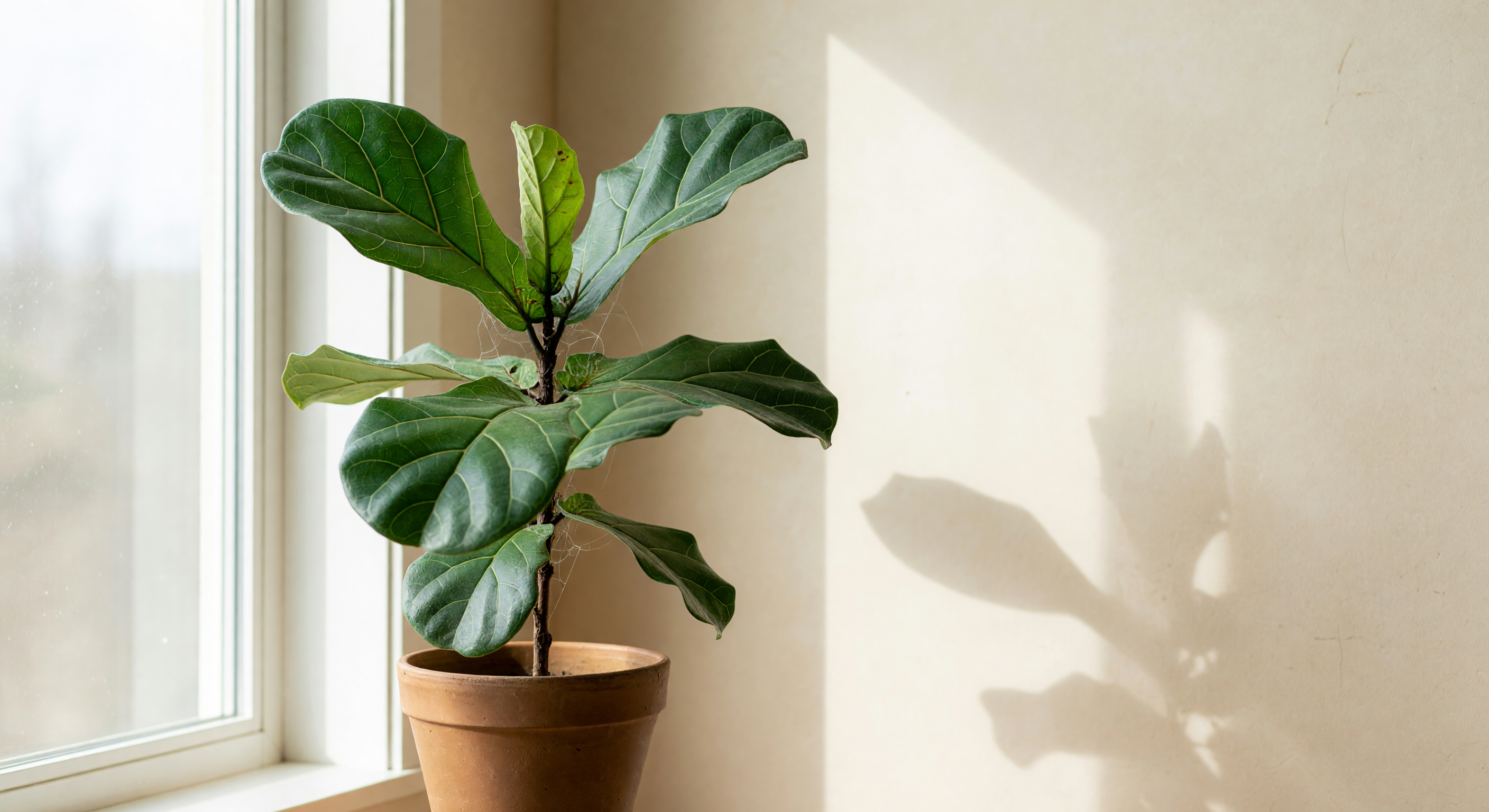
spider mites, edema, and leggy growth account for the three most common Fiddle Leaf Fig (Ficus lyrata) rescue cases we track. If your plant is showing webbing, red spots on new leaves, or stretching toward the nearest window, each problem has a documented cause and a specific fix.
Problem 1: Spider Mites
What’s Actually Happening
Spider mites (family Tetranychidae) are microscopic arachnids that feed on plant sap. They target Fiddle Leaf Figs because the large, flat leaves provide extensive surface area for colonization. infestations spike during the heating season when indoor humidity drops below 40%, or after environmental stress like relocation. Females lay hundreds of eggs in dry conditions, so early intervention determines whether treatment takes 2 weeks or 2 months.
The visible signs: fine webbing between leaf stems and the main trunk, speckled or dusty-looking leaf surfaces, and — under close inspection — tiny moving dots on leaf undersides.
 Spider mite identification: Look for fine webbing between stems, stippled yellow dots on leaves, and tiny moving specks on undersides.
How to Fix It
Step 1: Isolate Immediately
Move the Fiddle Leaf Fig away from all other plants. Spider mites spread to neighboring plants within days. Inspect every plant within a 3-foot radius for early webbing.
Step 2: Wipe Every Surface
Mix water with 70% isopropyl alcohol or use insecticidal soap. Wipe both sides of every leaf plus all stems and nodes. This physically removes mites and eggs. For severe infestations, repeat every 3-5 days for two full weeks.
Step 3: Raise Humidity to 60%+
Spider mites reproduce fastest in dry air. Run a humidifier near the plant or place it on a pebble tray with water. Maintain 60%+ humidity throughout the treatment period.
Step 4: Consider Biological Control
For high-value collections, predatory mites like Neoseiulus californicus feed on spider mites without harming the plant. This is the most effective long-term control for recurring infestations.
How to Prevent It
- Wipe leaves monthly with a damp cloth to remove dust and early colonies
- Maintain humidity above 50% year-round, especially during heating season
- Inspect new plants thoroughly before introducing them to your collection
- Quarantine new additions for 2-3 weeks before placing near existing plants
Problem 2: Edema (Red Spots on New Leaves)
What’s Actually Happening
Edema is a physiological disorder, not a disease or pest. It occurs when plant cells absorb water faster than they can transpire it, causing the cells to rupture. the root cause is inconsistent watering — what our data categorizes as “feast or famine” patterns.
The mechanism: when soil dries completely, the Fiddle Leaf Fig’s water uptake system slows. When you then water thoroughly, the roots absorb rapidly to compensate. Cells in tender new growth cannot handle the sudden influx and burst, creating the characteristic reddish-brown spots or raised, corky dots — typically on the newest leaves first, often while they are still unfurling.
 Edema identification: Reddish-brown spots or raised corky dots appear on newest leaves when cells rupture from inconsistent watering patterns.
How to Fix It
Step 1: Establish a Consistent Schedule
Check soil moisture every 7-10 days by inserting a finger 1-2 inches into the soil. When it feels dry at that depth, water thoroughly until water drains from the bottom of the pot.
Step 2: Water Deeply and Completely
Saturate the entire root ball each time you water. Partial watering leads to shallow root development and increases edema risk. Water until you see drainage from every hole in the pot.
Step 3: Ensure Proper Drainage
Remove standing water from saucers within 30 minutes of watering. If the pot lacks drainage holes, repot into a container with at least three drainage openings — this is non-negotiable for Fiddle Leaf Fig health.
Step 4: Accept Existing Spots
Existing edema marks are permanent on affected leaves. New growth will emerge clean once the watering schedule stabilizes. Focus on preventing new spots rather than reversing old ones.
How to Prevent It
- Set a recurring reminder to check soil moisture weekly
- Use a moisture meter if finger-testing feels unreliable
- Avoid compensatory heavy watering after missed sessions — return to the regular schedule
- Adjust frequency seasonally: less frequent in winter, more frequent in summer
Problem 3: Leggy Growth
What’s Actually Happening
Legginess in Fiddle Leaf Figs is etiolation — stem elongation caused by insufficient light. In low-light conditions, the plant produces longer internodes (gaps between leaves) as it reaches toward the nearest light source. this is one of the most frequently reported Fiddle Leaf Fig complaints, particularly when the plant is positioned in a corner or more than 4 feet from a window.
 Leggy growth comparison: Healthy compact growth with short internodes (left) versus etiolated stretched stems reaching for light (right). Solution: brighter light + pruning.
Fiddle Leaf Figs are also apically dominant, meaning they prioritize upward growth from the central growing tip. Without pruning intervention, they will not branch — they continue growing taller and more top-heavy with leaves clustered only at the crown.
How to Fix It
Step 1: Maximize Light Exposure
Move the Fiddle Leaf Fig directly in front of the brightest available window. West or south-facing windows are ideal. East-facing windows work with longer exposure. North-facing windows are generally insufficient without supplemental grow lights.
Step 2: Rotate Every Watering
Turn the plant 90 degrees each time you water. This prevents lopsided growth as the plant reaches toward its primary light source.
Step 3: Prune to Trigger Branching
Two methods, depending on how much reshaping is needed:
- Pinch method: Remove the top bud (the small growth point at the apex) by pinching it off. This activates dormant lateral buds below, encouraging horizontal branching.
- Top chop method: For more dramatic reshaping, cut the main stem 1-2 inches above the node where you want new branches to emerge. Use clean, sharp pruning shears. New growth will sprout from buds just below the cut within 2-4 weeks.
Step 4: Propagate the Cutting
The removed top section can be rooted in water or moist sphagnum moss. The cutting will branch naturally from the start since the apical bud has been removed.
How to Prevent It
- Position Fiddle Leaf Figs within 3-4 feet of bright windows that receive 10-12 hours of light
- Supplement with grow lights during winter months when daylight hours decrease
- Prune annually to maintain shape and encourage branching
- Provide adequate light from the start — there is no low-light workaround for this species
Recovery Timeline
| Problem | First Signs of Improvement | Full Recovery |
|---|---|---|
| Spider Mites | No new webbing (1-2 weeks) | 4-6 weeks |
| Edema | Next new leaf emerges without spots | 2-3 months (existing spots are permanent) |
| Leggy Growth | New growth appears after pruning (2-4 weeks) | 6-12 months for full structural reshape |
When to Worry
If webbing returns within 48 hours of treatment, the infestation is more advanced than surface-level — repeat the full wipe-down protocol and consider predatory mites. If edema spots appear on leaves that emerged after you stabilized your watering schedule, check for root damage or drainage obstruction. If no new growth appears within 6 weeks of pruning, the light level is still insufficient — add a supplemental grow light.
Separate issues that require different treatment: mushy stems near the soil line with bottom-up yellowing indicate root rot (requires unpotting and root trimming), white cottony masses or brown shell-like bumps are scale or mealybugs (different treatment from spider mites), and black mushy patches after cold exposure indicate cold damage from temperatures below 50°F (10°C).
The Bottom Line
Spider mites respond to humidity and physical removal within 2-4 weeks. Edema resolves with consistent watering — new growth emerges clean while old spots remain as cosmetic marks. Leggy growth requires both increased light and pruning to trigger branching, with full structural recovery taking 6-12 months. Most Fiddle Leaf Fig specimens recover fully when the specific environmental stressor is identified and corrected.