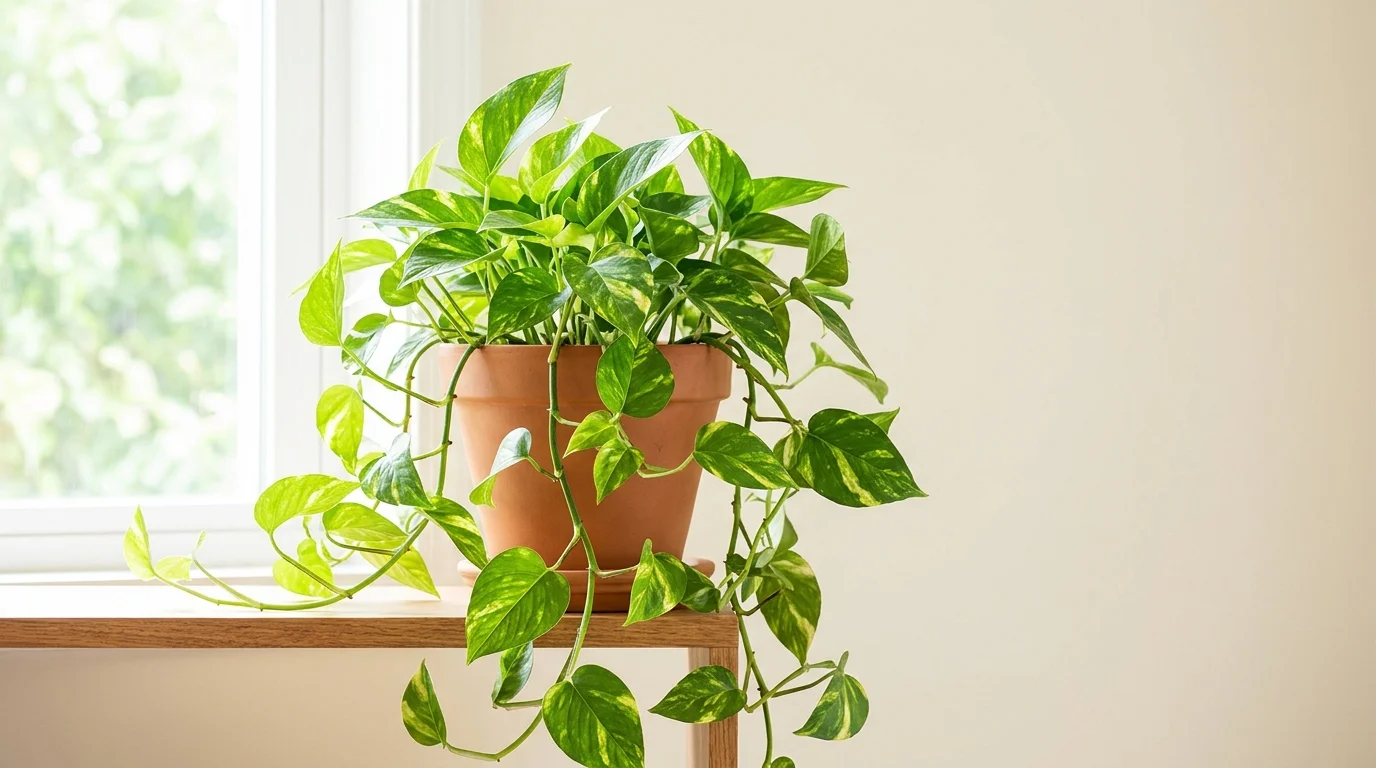
That first yellow leaf on your Pothos isn’t a death sentence — but it is a message. Pothos (Epipremnum aureum) tolerates neglect better than most houseplants, yet they still send clear signals when something’s off. Based on data gathered during 2025–2026, the vast majority of Pothos problems trace back to three fixable causes: watering frequency, pot size mismatches, and light conditions. This guide walks you through everything — from debunking the overwatering myth to treating pests — so you can stop guessing and start growing.
Why Pothos Is the Perfect Beginner Plant
Pothos earns its reputation as the ultimate starter plant for a reason. Native to the Society Islands in French Polynesia, Epipremnum aureum has adapted to thrive across tropical regions worldwide — from Southeast Asia to the Caribbean. This adaptability translates directly to indoor resilience.
Here’s what makes Pothos nearly indestructible:
- Tolerates low light — survives in north-facing windows where other plants leg out
- Handles irregular watering — bounces back from dramatic wilting within hours of watering
- Propagates effortlessly — root cuttings in plain water with 90%+ success rates
- Adapts to household humidity — no humidifier required, unlike Calathea or Fiddle Leaf Fig
- Grows fast — expect 12-18 inches of new vine growth per growing season under decent light
The trade-off? Pothos tells you when you’re messing up, but it doesn’t die immediately. That yellow leaf, those brown spots, the sudden droop — these are warnings, not eulogies. Learn to read them, and your Pothos will thrive for decades.
Watering: The Overwatering Myth
Let’s clear something up immediately: overwatering in Pothos isn’t about the volume of water you give. It’s about frequency.
Pothos can handle being thoroughly soaked — even flooded — if the soil drains properly and dries between waterings. True overwatering occurs when soil stays wet for extended periods, depriving roots of oxygen. However, Pothos actually prefer more moisture than many houseplants and tolerate wet conditions better than cacti or succulents. The real issue is waterlogged soil from poor drainage, oversized pots, or watering too often before soil dries.
The 2-Inch Test
This is the only watering rule you need:
- Push your finger 2-3 inches into the soil
- If it feels dry at that depth, water thoroughly
- If it feels damp or cool, wait 2-3 days and check again
- In winter, extend dry periods as growth slows
 The 2-inch test: Insert finger 2-3 inches deep. If dry, water thoroughly; if damp, wait and check again
Bottom Watering Works Better
For Pothos specifically, bottom watering encourages deeper root growth and prevents soil compaction:
- Place the pot in a saucer filled with 1-2 inches of water
- Let it soak for 15-30 minutes
- Remove and drain any excess
- Don’t water again until the top 2-3 inches are dry
If You’ve Already Overwatered
Accidentally flooded your Pothos? Here’s the recovery protocol:
- Drain the pot immediately — tilt it gently to remove standing water
- Do not water again until the soil is completely dry at 2-3 inches
- Increase air circulation around the plant
- If leaves continue yellowing, check roots for rot (mushy, brown roots = rot)
- Repot in fresh, well-draining aroid mix if root rot is present
Light Requirements by Variety
Pothos tolerates a wide light range, but different varieties have different needs. Understanding these distinctions prevents the two most common light-related problems: sunburn on variegated varieties and reversion to all-green growth in low light.
Golden Pothos (Epipremnum aureum ‘Aureum’)
- Ideal: Bright indirect light (10,000-15,000 lux)
- Tolerates: Low light (north-facing windows, 2,500-5,000 lux)
- Avoid: Direct afternoon sun — causes leaf scorch
Marble Queen & Manjula
- Ideal: Bright indirect light (15,000-20,000 lux)
- Tolerates: Medium light, but variegation fades in low light
- Avoid: Deep shade — reverts to green, slower growth
Neon Pothos
- Ideal: Medium to bright indirect light
- Tolerates: Lower light, but chartreuse color dulls
- Avoid: Direct sun — bright yellow leaves burn easily
Pearls and Jade
- Ideal: Bright indirect light
- Tolerates: Medium light
- Avoid: Low light — white variegation needs light to maintain
Global Distribution Context
Pothos is native to the Society Islands but has been introduced across tropical regions worldwide. This distribution tells you something critical: Pothos evolved under filtered canopy light, not direct equatorial sun. Replicate that dappled brightness indoors, and your plant thrives.
Soil Mixes That Actually Work
The “well-draining potting mix” advice you see everywhere is too vague. Pothos needs a specific texture: chunky, airy, and moisture-retentive without staying soggy.
The Ideal Aroid Mix
This recipe works for all Pothos varieties:
- 40% high-quality potting soil (not garden soil — too dense)
- 30% perlite (the white gravelly bits — critical for aeration)
- 20% orchid bark (chunky pine bark — mimics epiphytic conditions)
- 10% charcoal (optional — helps prevent root rot)
Signs Your Soil Mix Is Wrong
Too dense (stays wet >7 days):
- Roots suffocate, leading to root rot
- Soil smells musty or sour
- Pothos shows yellow leaves despite “proper” watering
- Fix: Repot with more perlite and orchid bark
Too fast-draining (dries in <3 days):
- Pothos wilts between waterings
- Lower leaves yellow and drop
- Soil pulls away from pot edges
- Fix: Add more potting soil or a handful of coco coir
Pot Size Matters More Than You Think
Community data shows pot-related issues dominate Pothos problems:
- Pot too small (390 documented cases) — roots can’t access water, plant wilts despite moist soil
- Root rot from pot (271 cases) — oversized pots hold water below root zone
- Nursery pot vs decorative pot (148 cases) — no drainage holes = drowning
Rule of thumb: Size up only 1-2 inches in diameter when repotting. A 6-inch plant needs a 6-8 inch pot, not a 10-inch planter.
Propagation Like a Pro
Pothos propagation is where beginners become confident plant parents. Success rates exceed 90% when you follow the right technique.
Water Propagation (Highest Success Rate)
- Cut below a node — the bump where leaves emerge (roots grow from nodes, not stem)
- Remove lower leaves — leave 2-3 leaves at the top, strip anything that would sit in water
- Place in room-temperature water — change weekly to prevent bacterial growth
- Wait 2-4 weeks — roots appear in 10-14 days, ready to pot at 2-3 inches long
- Pot when roots are 2-3 inches — don’t wait too long; water roots struggle to adapt to soil after getting too long
Soil Propagation (Faster Establishment)
- Cut as above — below a node, 4-6 inch cutting
- Dip in rooting hormone (optional — speeds rooting by ~1 week)
- Insert into moist potting mix — don’t bury leaves
- Cover with plastic bag — creates humidity dome
- Remove bag after 2 weeks — new growth means roots have established
Node Identification Is Critical
Every cutting MUST include at least one node. No node = no roots = dead cutting. Nodes look like:
- Small bumps or rings on the stem
- Slightly swollen areas where leaves or aerial roots emerge
- Often have a tiny brown nub (emerging root tip)
 Critical node identification: Roots grow from nodes (swollen stem areas), not from plain stem. Always cut below the node.
Cut below the node, not above it. The node itself goes into water or soil.
Pest Identification & Treatment
Pothos is relatively pest-resistant, but infestations happen. Early detection is everything — pests spread to nearby plants within days.
Mealybugs
Identification: White cottony masses on stems, leaf joints, and undersides Damage: Weakens plant by extracting sap; spreads rapidly
Treatment protocol:
- Quarantine affected plant immediately
- For small infestations: dab individual bugs with 70% rubbing alcohol on cotton swabs
- For larger infestations: spray with insecticidal soap or neem oil every 5-7 days for 3-4 weeks
- For root mealybugs: remove plant, rinse roots, trim rotted sections, soak in hydrogen peroxide solution (1:4 ratio), repot in fresh soil
- Monitor for 1-2 months as eggs hatch
Thrips
Identification: Silvery or translucent patches on leaves, black specks (frass), stunted new growth Damage: Rasps leaf tissue and sucks sap; reproduces rapidly indoors
Treatment protocol:
- Isolate infected plant immediately
- Spray entire plant with strong water to dislodge thrips (outdoors or in shower)
- Apply insecticidal soap or spinosad (Captain Jacks Dead Bug Brew) every 7-10 days for 3-4 cycles
- For severe infestations: use imidacloprid granules in soil
- Treat ALL nearby plants even if they show no symptoms
- Monitor with yellow sticky traps to catch adults
Note: Thrips are resistant to neem oil alone. Use spinosad or insecticidal soap.
Spider Mites
Identification: Tiny yellow or white dots (stippling), fine webbing on leaves and stems Damage: Feeds on leaf sap; thrives in hot, dry conditions
Treatment protocol:
- Increase humidity immediately — spider mites hate moisture
- Shower plant or mist heavily
- Spray leaves thoroughly with water, especially undersides
- Apply neem oil, insecticidal soap, or miticide every 3-5 days for 2-3 weeks
- For severe infestations: use chemical miticide
- Monitor with a magnifying glass — mites are barely visible
Prevention Beats Treatment
- Quarantine new plants for 2-4 weeks before placing near existing collection
- Inspect plants weekly, especially leaf joints and undersides
- Maintain 50-60% humidity
- Wipe leaves monthly to remove dust (pests settle on dirty leaves first)
- Avoid over-fertilizing with nitrogen — attracts pests
Variegation Care & Reversion
Variegated Pothos varieties (Marble Queen, Manjula, Pearls and Jade) require different care than all-green varieties. The white or cream sections lack chlorophyll, making them more sensitive and slower-growing.
Why Variegated Pothos Need More Light
White leaf sections can’t photosynthesize. To compensate:
- Variegated varieties need 20-30% more light than Golden or Neon Pothos
- Place within 3-5 feet of east or west-facing windows
- Supplement with grow lights in winter (12-14 hours/day)
Reversion: When Variegation Disappears
If your Marble Queen starts producing all-green leaves:
- Cause: Insufficient light — plant prioritizes chlorophyll production
- Fix: Move to brighter location immediately
- Prune: Cut off all-green vines at the base — they won’t revert back
- Patience: New growth takes 4-6 weeks to show variegation again
Sunburn on Variegated Leaves
White sections burn easily. Sunburn symptoms:
- Bleached, white or brown crispy patches
- Leaves remain firm (not mushy like root rot)
- Appears on newest leaves first
Recovery:
- Move immediately to bright indirect light
- Trim severely damaged leaves — they won’t recover
- Mildly affected leaves can stay — they still photosynthesize
- Acclimate gradually when moving locations (1 hour of morning sun, increasing over 2 weeks)
Problem Solving: Drooping, Curling, Yellowing
Let’s diagnose the three most common Pothos distress signals.
Yellow Leaves
Most likely cause: Overwatering (frequency, not volume) or natural aging
Diagnostic steps:
- Check which leaves are yellowing
- Lower/older leaves only = natural aging (normal, trim and move on)
- New growth or widespread yellowing = overwatering or light issue
- Feel the soil at 2-3 inches depth
- Wet or soggy = overwatering
- Dry = underwatering or rootbound
- Check your pot
- No drainage holes = waterlogging
- Massive pot = water pooling below roots
Solutions:
- For overwatering: Stop watering until soil is dry at 2-3 inches; improve drainage
- For underwatering: Bottom-water for 30 minutes; resume regular schedule
- For natural aging: Trim yellow leaves at the stem; nothing to fix
Drooping Leaves
Most likely cause: Underwatering, overpotting, or transplant shock
Diagnostic steps:
- Check soil moisture
- Bone dry = underwatering (most common)
- Wet = overpotting or root rot
- Assess pot size
- Pot is 4+ inches larger than root ball = overpotting
- Roots circling tightly = rootbound
- Consider recent changes
- Repotted in last 2 weeks = transplant shock
Solutions:
- For underwatering: Bottom-water by soaking 15-30 minutes for thorough hydration
- For overpotting: Repot into appropriately sized pot matching root ball
- For rootbound: Repot into slightly larger pot with fresh soil
- For transplant shock: Maintain consistent moisture and bright light; recovery in 1-2 weeks
Curling Leaves
Most likely cause: Underwatering/low humidity, transplant shock, or rootbound conditions
Diagnostic steps:
- Check soil moisture
- Dry = underwatering
- Moist = other cause
- Assess humidity
- Below 40% = low humidity stress
- Check for recent changes
- Water propagation to soil transition = normal adaptation (1-2 weeks)
Solutions:
- For underwatering: Water thoroughly and increase humidity to 50-60%
- For transplant shock: Keep soil consistently moist (not soggy) for 2-3 weeks
- For rootbound: Repot into slightly larger container
- For light response: Rotate plant weekly for even exposure
- Be patient — water-to-soil transitions can take 1-2 weeks for leaves to unfurl
Brown Spots
Multiple possible causes: Overwatering/edema, bacterial leaf spot, sunburn, or physical damage
Diagnostic steps:
- Examine the spots
- Water-soaked with yellow halos = bacterial leaf spot
- Uniformly brown, starting on lower leaves = overwatering
- Crispy, bleached patches = sunburn
- Check your watering routine
- Wet leaves after watering = bacterial risk
- Soil stays wet >7 days = overwatering
- Consider location
- Near south/west window without acclimation = sunburn
Solutions:
- For overwatering: Allow soil to dry, improve drainage, repot if root rot present
- For bacterial spot: Remove affected leaves, improve air circulation, avoid wetting foliage
- For sunburn: Move to indirect light, trim damaged leaves
- For physical damage: Wipe leaves with damp cloth; cosmetic only
Training & Support Structures
Pothos is a climbing vine in nature. Giving it something to climb triggers larger leaves and faster growth.
Moss Poles (Best for Large Leaves)
- Mimics natural tree-climbing behavior
- Aerial roots attach to moist moss, triggering fenestration-like leaf expansion
- Keep moss pole moist by watering it when you water the plant
- Expect leaves to double in size within 6-12 months
Trellises & Wire Frames
- Good for shaping Pothos into specific forms
- Use soft plant ties — don’t damage stems
- Train vines gradually; don’t force sharp bends
Hanging Baskets (Trailing Habit)
- No support needed — let vines cascade
- Rotate weekly for even growth
- Trim long vines to encourage bushiness (use cuttings for propagation)
When to Start Training
- Begin when vines reach 12+ inches long
- Shorter vines break easily during training
- Secure vines loosely at first; tighten as aerial roots attach
Pothos for Air Quality
Research confirms what plant parents have long suspected: Pothos actively improves indoor air quality. A 2024 study found that botanical bioscrubbers using Golden Pothos in hydroponic setups effectively reduce indoor air pollutants like CO2 and PM2.5, with removal efficiencies correlated to foliar area.
What Pothos Removes
- Formaldehyde — from pressed wood furniture, carpets
- Benzene — from plastics, synthetic fibers
- Xylene — from paints, adhesives
- CO2 — especially in closed environments
How Many Plants You Need
For measurable air quality improvement:
- 1 medium Pothos per 100 square feet for basic benefit
- 2-3 plants per 100 square feet for significant pollutant reduction
- Larger plants = more foliar area = better filtration
Placement for Maximum Benefit
- Near pollution sources (home office with printer, garage entry)
- In bedrooms for overnight CO2 reduction
- In high-traffic areas where particulates accumulate
Important Caveat
Pothos helps, but it’s not a replacement for ventilation. Open windows regularly, use HVAC filters, and treat plants as a supplement — not a substitute — for proper air exchange.
The Bottom Line
Pothos tolerates mistakes better than most houseplants, but it still communicates when something’s wrong. Yellow leaves usually mean watering frequency is off. Drooping signals thirst or pot size issues. Brown spots point to overwatering, bacteria, or sunburn. The fix is almost always simpler than you think: check soil moisture at 2-3 inches, ensure your pot drains, match light to your variety’s needs, and act fast on pests.
Master these fundamentals, and your Pothos will reward you with years of vigorous growth — trailing from shelves, climbing moss poles, or filling hanging baskets with minimal fuss.
Visual Prompts
{
  "hero": "A lush Golden Pothos (Epipremnum aureum) with variegated heart-shaped leaves cascading from a white ceramic hanging pot, one lower leaf showing slight yellowing at the base, bright morning light from east-facing window casting soft shadows, bright natural lighting, high-key, botanical editorial photography, clean composition, parchment-toned background, single plant focus, 16:9 cinematic horizontal composition, NOT dark, NOT moody, NOT over-saturated, NOT watermarked, NOT multiple plants, NOT stock photo aesthetic"
}