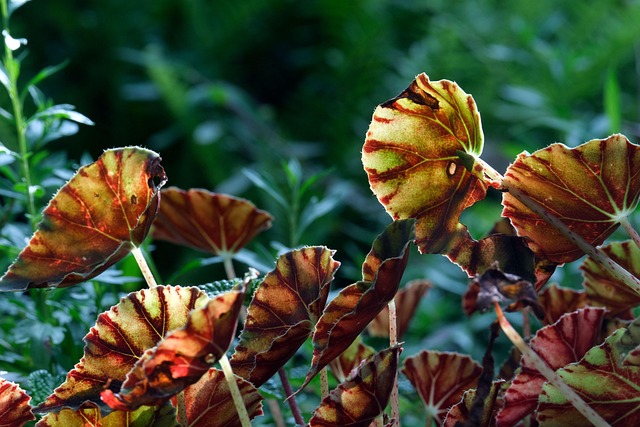
begonia maculata
Begonia maculata
Comprehensive care and diagnosis guide for the Begonia Maculata. Based on 11 verified community insights.
Care Requirements
At a Glance
Detailed care profile is currently being compiled by the Plant Grail swarm.
Start Here
Most Common Problems
Based on 11 analyzed cases — these are the issues you're most likely to encounter
Why does my Begonia Maculata have care requirements?
Begonia maculata (Polka Dot Begonia) is a tropical understory plant native to...
How do I propagate my Begonia Maculata?
Begonia maculata propagates readily from stem cuttings due to meristematic...
Why does my Begonia Maculata have common problems?
Begonia maculata exhibits distinct stress responses: leaf drop typically...
Why does my Begonia Maculata have light needs?
Begonia maculata evolved as an understory plant in Brazil's Atlantic Forest,...
Why does my Begonia Maculata have watering?
Begonia maculata's rhizomatous root system requires consistent moisture but is...
Verified Data
All Diagnoses
Complete analysis of 11 cases for this variety. Select an entry to expand rescue protocols.
Environment (1)
Other Problems (3)
Propagation (1)
Watering Issues (1)
Common Questions
Frequently Asked Questions
Why does my begonia maculata have Care requirements?
Cause: Begonia maculata (Polka Dot Begonia) is a tropical understory plant native to Brazil's Atlantic Forest, requiring specific environmental conditions to thrive. The plant's distinctive spotted foliage and cane-like stems evolved in high-humidity (60-80% RH), warm (65-80°F), and bright filtered light conditions. Its rhizomatous root system is highly susceptible to anaerobic conditions, making soil composition and watering practices critical to survival.
Solution: Maintain ambient humidity at 60-80% using a humidifier or pebble tray—never mist leaves directly as this promotes powdery mildew
Prevention: Establish consistent environment before plant arrival: set up humidifier 2-3 days prior, acclimate gradually over 7-10 days, use clear nursery pots to monitor root health, and maintain stable temperatures between 65-80°F year-round.
90% confidence · View full protocol →
Why does my begonia maculata have Propagation?
Cause: Begonia maculata propagates readily from stem cuttings due to meristematic tissue at nodes that can differentiate into adventitious roots. The plant's natural habitat experiences seasonal flooding, creating an evolutionary adaptation for root development in moist conditions. However, prolonged water propagation leads to bacterial rot and weak water roots that struggle to transition to soil, explaining the high failure rate when cuttings are left in water too long.
Solution: Take 4-6 inch stem cuttings with 2-3 nodes, cutting just below a node with sterilized scissors
Prevention: Avoid extended water propagation beyond 3-4 weeks; transition immediately upon shoot emergence to leverage natural geophytic adaptation; use sterile tools and filtered water to prevent bacterial contamination.
87% confidence · View full protocol →
Why does my begonia maculata have Common problems?
Cause: Begonia maculata exhibits distinct stress responses: leaf drop typically signals overwatering-induced root rot (affecting lower leaves first) or low humidity shock (affecting newer growth), while brown spots indicate either fungal/bacterial infection from water on leaves or sunburn from direct light exposure. The confusion arises because both underwatering and overwatering can cause leaf drop, requiring root inspection for accurate diagnosis.
Solution: For leaf drop: Unpot and inspect roots—trim all brown/mushy roots, repot in dry fresh mix, withhold water 5-7 days
Prevention: Maintain consistent 60-80% humidity without leaf wetting; use bottom-watering to keep foliage dry; provide bright indirect light only; check soil moisture with finger test before watering; quarantine new plants for 2 weeks.
88% confidence · View full protocol →
Why does my begonia maculata have Light needs?
Cause: Begonia maculata evolved as an understory plant in Brazil's Atlantic Forest, adapted to bright filtered light with dappled sun penetration through the canopy. Scientific studies on Begonia species demonstrate that light quality and intensity regulate lipid metabolism and stress adaptation. Insufficient light causes leggy growth and leaf drop, while excessive direct sun causes photodamage and leaf scorch, particularly on the characteristic spotted foliage.
Solution: Provide bright indirect light of 2000-4000 lux measured with light meter
Prevention: Acclimate to new light conditions gradually over 7-10 days; monitor for signs of light stress (leggy growth = too little; brown crispy spots = too much direct sun); maintain consistent light levels year-round adjusting for seasonal changes.
91% confidence · View full protocol →
Why does my begonia maculata have Watering?
Cause: Begonia maculata's rhizomatous root system requires consistent moisture but is highly susceptible to anaerobic bacterial and fungal pathogens (Pythium, Erwinia) when soil remains saturated for extended periods. The plant's thin stems and spotted leaves create a diagnostic challenge: soft stems indicate overwatering/rot, while crispy leaves suggest underwatering. The key is balancing moisture without waterlogging, as 7+ days of saturated soil triggers root rot that can kill the plant within days.
Solution: Check soil moisture with finger test: water only when top 2 inches are completely dry
Prevention: Use terracotta pots with drainage holes and well-draining soil mix (50% peat, 30% perlite, 20% bark); maintain 60-80% humidity to reduce water needs; avoid automated watering systems; adjust frequency seasonally based on light and temperature.
89% confidence · View full protocol →