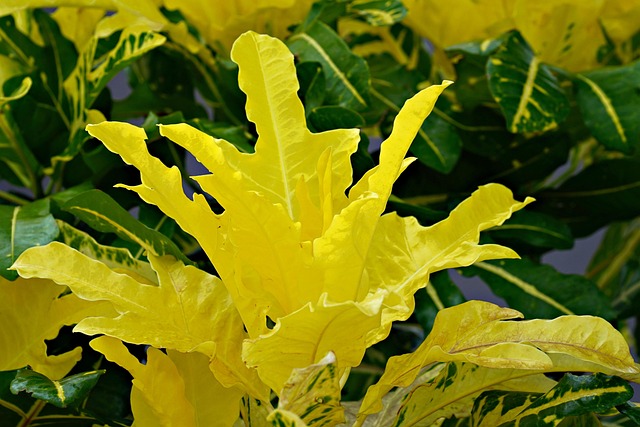
croton
Codiaeum variegatum
Also known as: Codiaeum
Evidence-based care guide for Croton (Codiaeum variegatum). Covers disease treatment, pest control, lighting and watering. Our analysis draws from 26 verified community cases with an average confidence score of 88%. Each protocol is synthesized from real rescue outcomes, not generic advice.
Care Essentials
Get to Know Your Croton
Watch the humidity — a little extra moisture in the air goes a long way with this plant.
Light
bright indirect
Wants bright, indirect light — sensitive to both extremes. Too much direct sun causes burns, too little causes stretching.
💡 Grow lights: Thrives under artificial grow lights (LED or fluorescent, 10-12 hours/day). A great option if your space lacks natural light.
Watering
every 7-10 days
Water when the top 1-2 inches of soil feel dry. Adjust with the seasons — less in winter, more in summer.
Humidity & Temperature
Loves higher humidity (60%+). If your air is dry, group it with other plants, use a pebble tray, or run a humidifier nearby.
Standard room temperature (60-80°F / 15-27°C) is perfect. Avoid cold drafts and sudden temperature swings.
Soil
Needs well-draining soil — add perlite or orchid bark to a standard potting mix. Good drainage is critical to prevent root rot.
Care Requirements
At a Glance
Care Profile in Development
While our detailed care profile is being compiled, you can find specific care guidance in the 6 care-related diagnoses below — including watering schedules, light requirements, and propagation methods from real-world cases.
Start Here
Most Common Problems
Based on 26 analyzed cases — these are the issues you're most likely to encounter
Don't see your symptom? Search all 21 topics below, or run the Diagnostic.
Does my Croton need more humidity?
Crotons require 50-70% relative humidity (RH) to maintain healthy transpiration...
Croton: Dropping Leaves
Environmental stress triggers rapid leaf abscission in Codiaeum variegatum....
Why is my Croton dropping leaves?
Crotons undergo rapid leaf abscission (dropping) as a stress response to...
Why is my Croton losing its variegation?
Insufficient light intensity causes chlorophyll overproduction in Codiaeum...
Why does my Croton have spider mites?
Spider mite (Tetranychus urticae) infestation on Croton (Codiaeum variegatum)...
Which of the 7 Killers
is threatening your plants?
We analyzed 1,616 documented plant deaths to identify the 7 causes behind 78% of all losses. Answer 5 questions — we'll tell you exactly which ones apply to your setup.
Skip the quiz — get The 7 Killers course ($19) →Question 1 of 5
How do you decide when to water your plants?
Question 2 of 5
Where do most of your plants live?
Question 3 of 5
What's your home environment like?
Question 4 of 5
Have you lost a plant in the last 6 months?
Question 5 of 5
How often do you check your plants for pests?
Your diagnosis is ready
We've identified your top 2 risk killers. Enter your email to see the full breakdown and your personalized rescue protocol.
Your plants are most at risk from:

The 7 Killers mini-course covers every one of these in depth — mechanism, rescue protocol, prevention. 1,616 cases. 7 lessons. $19.
Get The 7 Killers — $19 →Get the Plant Mortality Checklist
The 7 killers behind 78% of houseplant deaths — and the exact fix for each. Free PDF based on 1,616 documented cases.
Your checklist is ready!
We also sent it to your inbox. Check your email for the full download.
Open the ChecklistFree. No spam. Unsubscribe anytime.
Verified Data
All Diagnoses
21 topics consolidated from 26 documented cases. Expand any topic to see all protocols.
Symptoms (1 topics · 1 cases)
Why is my Croton wilting?
Croton (Codiaeum variegatum) drooping signals two distinct etiologies
90%
Why is my Croton wilting?
Croton (Codiaeum variegatum) drooping signals two distinct etiologies
Cause
Croton (Codiaeum variegatum) drooping signals two distinct etiologies. TRANSIENT WILT: Rapid leaf drooping from underwatering due to high transpiration rates from large, thin, variegated leaves—recovery occurs within 1-24 hours post-watering. ROOT DYSFUNCTION: Persistent drooping with moist soil indicates root rot (anaerobic conditions blocking uptake), rootbound stress (circling roots restricting growth), or spider mite damage exacerbating water uptake. Key differentiator: Dry soil + quick recovery = transient wilt; moist soil + no recovery = investigate roots.
Solutions
- Check soil moisture: Insert finger 2 inches deep—bone-dry confirms underwatering
- Water thoroughly: Saturate until drainage flows freely; expect recovery within hours
- If soil moist: Unpot and inspect roots—trim black/mushy rot, rinse healthy roots, repot in sterile mix
- If roots circling: Repot into container 2-4 inches larger with fresh well-draining mix
- Inspect for spider mites: Check leaf undersides for webbing/stippling; treat with neem oil if found
- Monitor environment: Maintain 65-85°F, 50-70% humidity, bright indirect light
Prevention
Water consistently when top inch of soil dries—Crotons need frequent watering due to tropical origin and thin leaf structure. Ensure excellent drainage (never allow standing water). Boost humidity to 50-70% via humidifier or grouping plants. Acclimate new plants gradually over 1-2 weeks to prevent transplant shock. Repot annually in spring before roots become severely rootbound.
Diseases (1 topics · 1 cases)
Why does my Croton have root rot?
Root rot in Croton (Codiaeum variegatum) develops when thin, fibrous roots remain in waterlogged, poorly aerated soil for extended periods
87%
Why does my Croton have root rot?
Root rot in Croton (Codiaeum variegatum) develops when thin, fibrous roots remain in waterlogged, poorly aerated soil for extended periods
Cause
Root rot in Croton (Codiaeum variegatum) develops when thin, fibrous roots remain in waterlogged, poorly aerated soil for extended periods. Unlike succulents with water-storing tissues, crotons require oxygen exchange at root level. Oversized pots retain excess moisture that slow-drying dense potting soil exacerbates, creating anaerobic conditions favoring Pythium and Fusarium pathogens. The plant's drooping leaves often mimic underwatering, leading to more watering and accelerating rot.
Solutions
- Unpot immediately: Gently remove from container and inspect root ball
- Trim affected tissue: Cut all black, mushy, or foul-smelling roots with sterilized scissors, extending 0.5 inches into healthy white tissue
- Sterilize remaining roots: Soak in 3% hydrogen peroxide solution (1:1 with water) for 20 minutes to kill pathogens
- Repot in appropriate container: Select pot only 1-2 inches wider than trimmed root ball with drainage holes
- Use fresh airy mix: Combine 50% potting soil + 30% perlite + 20% orchid bark to prevent future compaction
- Resume watering carefully: Wait 7 days after repotting, then water only when top 2-3 inches are dry
Prevention
Use well-draining mix: 50% potting soil, 30% perlite, 20% orchid bark. Match pot size to root ball—excess soil volume retains unwanted moisture. Water only when top 2 inches are completely dry. Ensure pot has drainage holes; avoid decorative cache pots without drainage.
Pests (3 topics · 3 cases)
Why does my Croton have mealybugs?
Mealybugs attracted to tender new growth and sap
88%
Why does my Croton have mealybugs?
Mealybugs attracted to tender new growth and sap
Cause
Mealybugs attracted to tender new growth and sap. Thrive in warm humid conditions with poor airflow. Stressed plants more susceptible.
Solutions
- Isolate infested plant immediately
- Remove mealybugs manually with alcohol-dipped cotton swabs
- Apply insecticidal soap or neem oil every 7-10 days for 3-4 weeks
- Use systemic insecticide for severe infestations
- Inspect and treat nearby plants
- Prune heavily infested stems
Prevention
Quarantine new plants for 2-4 weeks. Maintain good air circulation. Avoid over-fertilizing. Apply preventive neem oil monthly.
What pests are on my Croton?
Crotons are susceptible to sap-feeding pests including spider mites, mealybugs, scale, and thrips
86%
What pests are on my Croton?
Crotons are susceptible to sap-feeding pests including spider mites, mealybugs, scale, and thrips
Cause
Crotons are susceptible to sap-feeding pests including spider mites, mealybugs, scale, and thrips. Spider mites thrive in hot, dry conditions (<40% humidity) and cause stippling, webbing, and leaf drop. Mealybugs appear as white cottony masses on stems and leaf joints. Pests extract sap, weaken plant vigor, and transmit pathogens. Low humidity and poor air circulation accelerate infestations.
Solutions
- Isolate affected croton immediately to prevent pest spread to nearby plants
- For spider mites: Shower plant thoroughly (especially leaf undersides), apply neem oil or insecticidal soap every 5-7 days for 3-4 weeks
- For mealybugs: Dab individual pests with 70% isopropyl alcohol on cotton swabs; spray infested areas with insecticidal soap weekly
- For scale: Scrape off with soft brush, apply horticultural oil to suffocate remaining scale, repeat in 10 days
- Increase humidity to 60%+ and improve air circulation to create unfavorable pest environment
Prevention
Maintain 50-70% humidity to deter spider mites. Inspect new plants for 2-4 weeks before introducing to collection. Wipe leaves monthly with damp cloth. Ensure good air circulation without cold drafts. Quarantine infested plants immediately.
Why does my Croton have spider mites?
Spider mite (Tetranychus urticae) infestation on Croton (Codiaeum variegatum) proliferates in low-humidity indoor environments below 50% RH
92%
Why does my Croton have spider mites?
Spider mite (Tetranychus urticae) infestation on Croton (Codiaeum variegatum) proliferates in low-humidity indoor environments below 50% RH
Cause
Spider mite (Tetranychus urticae) infestation on Croton (Codiaeum variegatum) proliferates in low-humidity indoor environments below 50% RH. These arachnid pests feed on leaf sap, causing stippling—tiny yellow/white dots on foliage—and fine silken webbing on undersides. The 7-14 day egg-to-adult lifecycle enables explosive population growth in dry conditions that also stress the plant, reducing its defensive capabilities. Croton's thin leaves and preference for high humidity make it particularly susceptible.
Solutions
- Isolate plant immediately to prevent spread to other plants
- Shower treatment: Rinse entire plant with strong water spray focusing on leaf undersides; repeat every 3-5 days for 2-3 weeks to break lifecycle
- Apply neem oil: Mix 1-2 tsp neem oil + 1 tsp dish soap per quart water; spray all surfaces including undersides; apply in evening to prevent leaf burn
- Increase humidity: Boost to 60%+ RH immediately—dry air favors mite reproduction while hampering recovery
- Monitor with loupe: Check for remaining mites/webbing weekly; continue treatment 2 weeks after last sighting
- Prune heavily infested leaves: Remove beyond recovery to reduce pest load and improve air circulation
Prevention
Maintain 60-70% humidity via humidifier or pebble tray—mites cannot thrive above 50% RH. Inspect weekly with 10x loupe, checking leaf undersides. Quarantine new plants for 2 weeks. Shower plants monthly to dislodge early colonizers.
Watering Issues (2 topics · 2 cases)
Is my Croton overwatered?
Croton root rot develops when soil remains waterlogged for 5+ days, creating anaerobic conditions that promote Pythium and Fusarium fungal growth
88%
Is my Croton overwatered?
Croton root rot develops when soil remains waterlogged for 5+ days, creating anaerobic conditions that promote Pythium and Fusarium fungal growth
Cause
Croton root rot develops when soil remains waterlogged for 5+ days, creating anaerobic conditions that promote Pythium and Fusarium fungal growth. Unlike drought-tolerant succulents, crotons have fine, fibrous root systems requiring oxygen exchange between waterings. Overwatering - watering before top 2 inches of soil dry - causes root tissue to suffocate and decay. Early signs include yellowing lower leaves, wilting despite wet soil, and reduced variegation. Advanced rot produces foul-smelling soil, mushy stems at base, and complete leaf drop. Root rot progresses rapidly in standard potting soil without drainage amendments.
Solutions
- Stop watering immediately and allow soil to dry completely
- Unpot plant and inspect roots - healthy roots are white/firm; rotted roots are black/mushy/foul-smelling
- Trim ALL rotted roots with sterile scissors until only firm white tissue remains
- Repot in fresh well-draining mix: 50% potting soil + 30% perlite + 20% orchid bark
- Water only when top 2-3 inches of soil are completely dry; use moisture meter for accuracy
Prevention
Water only when top 2 inches dry - use finger test or moisture meter. Ensure pot has multiple drainage holes. Use terracotta or unglazed ceramic pots that wick excess moisture. Avoid self-watering devices. Never let pot sit in standing water.
How often should I water my Croton?
Crotons (Codiaeum variegatum) have thin, fibrous root systems highly vulnerable to both desiccation and rot
85%
How often should I water my Croton?
Crotons (Codiaeum variegatum) have thin, fibrous root systems highly vulnerable to both desiccation and rot
Cause
Crotons (Codiaeum variegatum) have thin, fibrous root systems highly vulnerable to both desiccation and rot. Unlike succulents, they cannot tolerate bone-dry soil; unlike ferns, they cannot handle waterlogged conditions. Overwatering causes anaerobic bacterial proliferation (Pythium, Phytophthora) leading to root rot within 7-14 days in poorly draining soil. Underwatering triggers rapid turgor loss and dramatic wilting ("thirst droop") as leaves dehydrate. The narrow moisture window makes watering technique critical—soil must dry appropriately between waterings but never become completely desiccated.
Solutions
- Moisture monitoring: Use finger test—insert finger 2-3 inches deep; water only when dry at that depth, not surface
- Watering technique: Drench thoroughly until water exits drainage holes; discard excess after 30 minutes; never let pot sit in standing water
- Pot selection: Use containers with multiple drainage holes; terracotta helps wick excess moisture; avoid oversized pots that retain water
- Soil requirements: Well-draining mix—50% quality potting soil + 30% perlite/pumice + 20% coarse bark or coco chips
- Environmental adjustments: Increase watering frequency in hot, bright, or low-humidity conditions; reduce to every 10-14 days in cool, dim, or humid environments
- Recovery from overwatering: If suspected, unpot immediately, trim black/mushy roots, repot in fresh dry mix, resume watering after 1 week
Prevention
Establish consistent watering routine based on soil dryness rather than calendar schedule. Use moisture meter for precision. Ensure pots have drainage and soil is airy. Group with humidity-loving plants to reduce overall water needs. When in doubt, underwater slightly—crotons recover faster from drought than from root rot.
Environment (1 topics · 3 cases)
Does my Croton need more humidity?
Crotons require 50-70% relative humidity (RH) to maintain healthy transpiration and nutrient uptake
3 protocols
87–90%
Does my Croton need more humidity?
Crotons require 50-70% relative humidity (RH) to maintain healthy transpiration and nutrient uptake
Protocol 1: humidity · 90% confidence
Cause
Crotons require 50-70% relative humidity (RH) to maintain healthy transpiration and nutrient uptake. When indoor humidity drops below 40% - common in heated or air-conditioned homes - vapor pressure deficit (VPD) increases dramatically. This causes stomata to close as a protective measure, reducing gas exchange and photosynthesis. Chronic low humidity leads to reduced growth, leaf drop, and crispy margins as cells lose turgor pressure. Crotons are among the most humidity-sensitive common houseplants, showing stress symptoms before other tropical species.
Solutions
- Maintain 60-70% RH using humidifier running 8-12 hours daily
- Group plants together to create microclimate with 10-15% higher local humidity
- Use pebble trays with water level below pot base for passive humidity increase
- Monitor with digital hygrometer positioned at plant canopy level
- Mist leaves only if combined with other methods - misting alone provides minimal benefit
Prevention
Install humidifier before bringing croton home. Avoid placement near HVAC vents, radiators, or drafty windows. Choose bathroom or kitchen placement where humidity naturally higher. Monitor RH weekly, increasing humidity before symptoms appear.
Protocol 2: low humidity · 88% confidence
Cause
Low humidity stress in Croton (Codiaeum variegatum) develops when ambient relative humidity drops below 40-50%, common in heated or air-conditioned indoor environments. Native to tropical regions with 70%+ humidity year-round, crotons experience high vapor pressure deficit (VPD) in dry air that accelerates transpiration beyond root uptake capacity. Stomata close to conserve water, triggering ethylene-mediated leaf abscission. Chronic low humidity also weakens the plant's defenses, predisposing it to spider mite infestations that thrive in dry conditions.
Solutions
- Measure current humidity: Place digital hygrometer at plant level for 24-hour reading—below 40% confirms diagnosis
- Deploy humidifier: Use cool-mist humidifier near plants set to 60% target; run continuously in winter heating season
- Create pebble tray: Fill shallow tray with pebbles and water; set pot on top so base is above water line—evaporative humidity
- Group plants: Cluster tropicals together; collective transpiration raises local humidity 10-15%
- Relocate away from heat sources: Move 3+ feet from radiators, heat vents, or space heaters
- Misting is insufficient: Daily misting evaporates in minutes—rely on ambient humidity methods instead
- Check for secondary issues: Low humidity often coincides with spider mite infestations—inspect with 10x loupe
Prevention
Maintain 50-70% RH consistently: Use humidifier with hygrometer feedback, pebble trays with water below pot level (not touching), or group plants to create microclimate. Avoid placement near heat vents, radiators, or air conditioning units that create localized dry zones. Monitor with digital hygrometer placed at plant level.
Protocol 3: humidity · 87% confidence
Cause
Codiaeum variegatum is a humidity-sensitive tropical requiring 50-70% relative humidity. Indoor environments below 40% RH create excessive vapor pressure deficit (VPD), causing rapid transpiration that roots cannot match. Stomatal closure occurs to conserve water, triggering leaf abscission via ethylene production. Heating systems and air conditioning exacerbate dry air stress.
Solutions
- Measure humidity with digital hygrometer; target 50-70% RH consistently
- Install humidifier or use pebble tray (water level below pot bottom) for immediate humidity boost
- Group croton with other tropicals to create humid microclimate through collective transpiration
- Stop misting alone—it provides only temporary humidity spike and can promote fungal issues
- Relocate away from heat sources (radiators, heating vents) that create localized dry air pockets
Prevention
Maintain 50-70% humidity year-round using automated humidifier with hygrometer feedback. Group tropical plants together to create microclimate. Use pebble trays with water beneath pots. Avoid placement near HVAC vents, radiators, and drafty windows.
Care Methods (2 topics · 2 cases)
Care Guide: Croton Guide
Codiaeum variegatum (Croton) requires tropical conditions to maintain vibrant leaf coloration
90%
Care Guide: Croton Guide
Codiaeum variegatum (Croton) requires tropical conditions to maintain vibrant leaf coloration
Cause
Codiaeum variegatum (Croton) requires tropical conditions to maintain vibrant leaf coloration. The plant's thin, variegated leaves demand consistent moisture, high humidity (50-70%), and bright light to support photosynthesis across multiple color sectors. Unlike succulent-type houseplants, Crotons cannot store water efficiently, making them vulnerable to rapid dehydration. Color fading indicates insufficient light—variegation requires more energy than solid green leaves. Indoor heating and low humidity stress causes leaf curling, browning tips, and pest susceptibility.
Solutions
- Light: Bright indirect light (300+ FC) minimum; tolerate some direct morning sun for best color
- Watering: Water thoroughly when top 1 inch of soil is dry—every 5-7 days typically
- Humidity: Maintain 50-70% via humidifier, pebble trays, or grouping plants
- Temperature: 65-85°F optimal; avoid drafts, heating vents, AC blasts
- Soil: Well-draining potting mix with perlite (30%) to prevent waterlogging
- Pot: Ensure drainage holes; terracotta or ceramic works well
- Fertilizer: Balanced liquid fertilizer at 1/2 strength every 2 weeks during growing season
- Maintenance: Wipe leaves monthly to remove dust and support photosynthesis
Prevention
Consistency is critical—Crotons reject erratic care. Establish regular watering schedule based on soil moisture checks, not arbitrary timing. Maintain humidity above 50% year-round, especially in winter. Provide stable bright light location without frequent moves. Monitor for pests weekly (spider mites common on stressed Crotons). Repot annually in spring to prevent rootbound stress.
Care Requirements: Croton Guide
Crotons (Codiaeum variegatum) are tropical understory plants native to Southeast Asia requiring specific conditions to thrive indoors: high humidity (50-70%), consistent warmth (65-85°F), bright light (3000-6000 lux), and well-draining soil
86%
Care Requirements: Croton Guide
Crotons (Codiaeum variegatum) are tropical understory plants native to Southeast Asia requiring specific conditions to thrive indoors: high humidity (50-70%), consistent warmth (65-85°F), bright light (3000-6000 lux), and well-draining soil
Cause
Crotons (Codiaeum variegatum) are tropical understory plants native to Southeast Asia requiring specific conditions to thrive indoors: high humidity (50-70%), consistent warmth (65-85°F), bright light (3000-6000 lux), and well-draining soil. Their finicky reputation stems from sensitivity to environmental fluctuations—unlike hardy houseplants like pothos or snake plants, crotons cannot tolerate low humidity, temperature swings, or inconsistent care. Failure to meet these requirements results in rapid leaf drop, color loss, and decline within weeks of purchase.
Solutions
- Environmental assessment: Verify home can maintain 50%+ humidity and 3000+ lux light before acquiring; use phone apps or inexpensive meters
- Humidity management: Install humidifier set to 50-70% RH, use pebble trays, or group with other tropicals; misting alone is ineffective
- Lighting setup: Position in brightest window (south/west) with 6+ hours indirect light; supplement with grow lights if needed
- Soil preparation: Use well-draining mix (50% potting soil + 30% perlite + 20% bark) in pots with drainage holes
- Acclimation protocol: Quarantine new plants for 14 days in stable high-humidity recovery chamber before integrating into home
- Monitoring routine: Check soil moisture weekly with finger test; water when top 2-3 inches dry; watch for early stress signals
Prevention
Only acquire crotons if you can provide tropical conditions year-round. Beginners should start with more forgiving plants (pothos, snake plant) before attempting crotons. Invest in humidity monitoring and supplemental lighting before purchase.
Other Topics (11 topics · 14 cases)
Croton: Acclimation Shock
Acclimation shock in Croton (Codiaeum variegatum) occurs when the plant is abruptly moved from its established microclimate—whether from nursery to home, between rooms, or after repotting
89%
Croton: Acclimation Shock
Acclimation shock in Croton (Codiaeum variegatum) occurs when the plant is abruptly moved from its established microclimate—whether from nursery to home, between rooms, or after repotting
Cause
Acclimation shock in Croton (Codiaeum variegatum) occurs when the plant is abruptly moved from its established microclimate—whether from nursery to home, between rooms, or after repotting. Native to tropical Southeast Asian forests with stable 70%+ humidity and consistent warmth, crotons lack the physiological flexibility to adapt quickly to altered light intensity, humidity levels, temperature, or air circulation. The stress triggers ethylene production that activates pre-formed abscission layers at leaf petioles, causing rapid leaf drop as the plant redirects energy from maintaining foliage to survival.
Solutions
- Do not move again: Stabilize in current location for minimum 2-4 weeks despite leaf drop
- Boost humidity immediately: Raise to 60-70% RH via humidifier—critical for recovery during stress
- Maintain bright indirect light: 2000-5000 lux supports remaining foliage and new growth emergence
- Water carefully: Check top 2 inches dry before watering; overwatering compounds shock
- Remove fallen leaves: Prune at base to prevent mold and redirect plant energy
- Expect 4-8 week recovery: New growth at stem nodes indicates successful acclimation; do not fertilize until growth resumes
- Use humidity dome: For severe cases, cover with clear plastic bag with ventilation holes for 1-2 weeks
Prevention
Gradual transition: Cover with paper bag for 2-3 days when moving to reduce light shock. Maintain 50-70% humidity throughout transition. Avoid repotting within 30 days of acquisition. Keep temperature stable 65-85°F. Minimize environmental variables—change only one factor at a time.
Croton: Color Loss
Codiaeum variegatum requires high light intensity (500+ foot-candles) to maintain vibrant leaf variegation
85%
Croton: Color Loss
Codiaeum variegatum requires high light intensity (500+ foot-candles) to maintain vibrant leaf variegation
Cause
Codiaeum variegatum requires high light intensity (500+ foot-candles) to maintain vibrant leaf variegation. Insufficient light triggers chlorophyll overproduction as the plant compensates for reduced photosynthesis, causing colorful variegated patterns to fade to green. This is a photoprotective response distinct from sunburn, which causes bleached white patches.
Solutions
- Move to south-facing window with 6+ hours of direct sunlight daily
- Supplement with full-spectrum LED grow light (6500K, 200+ foot-candles) for 12-14 hours daily if natural light is insufficient
- Rotate plant 90° weekly for even light exposure and symmetrical color development
- Avoid sudden light changes—acclimate gradually over 2 weeks to prevent shock
Prevention
Maintain bright direct light year-round. Use light meter app to verify 500+ foot-candles at leaf level. Expect gradual color loss in winter due to reduced light intensity; supplement with grow lights during low-light months.
Croton: Crispy Leaves
Croton leaves develop crispy brown edges and tips when ambient humidity drops below 40% RH
89%
Croton: Crispy Leaves
Croton leaves develop crispy brown edges and tips when ambient humidity drops below 40% RH
Cause
Croton leaves develop crispy brown edges and tips when ambient humidity drops below 40% RH. As tropical understory plants native to Malaysia and Pacific Islands where humidity exceeds 70%, crotons have thin leaf cuticles that cannot prevent rapid water loss in dry indoor air. Low humidity triggers stomatal closure to reduce transpiration, but this causes cellular dehydration at leaf margins where vascular tissue ends. Unlike overwatering (which causes soft brown spots), crispy edges are dry and papery. Misting temporarily wets leaves but does not raise ambient humidity meaningfully.
Solutions
- Install digital hygrometer near plant; maintain 50-70% RH
- Use humidifier placed 3-5 feet from plant running 6-8 hours daily
- Create pebble tray with water level below pot bottom to increase local humidity 5-10%
- Group with other tropical plants to create humidity microclimate via transpiration
- Trim crispy edges with sterile scissors at natural leaf angle for aesthetics
Prevention
Position humidifier to target 60%+ humidity consistently before symptoms appear. Avoid placement near heating vents, fireplaces, or drafty areas. Group with other humidity-loving plants. Monitor weekly with hygrometer during winter heating season.
Croton: Dropping Leaves
Environmental stress triggers rapid leaf abscission in Codiaeum variegatum
2 protocols
88–90%
Croton: Dropping Leaves
Environmental stress triggers rapid leaf abscission in Codiaeum variegatum
Protocol 1: dropping leaves · 90% confidence
Cause
Environmental stress triggers rapid leaf abscission in Codiaeum variegatum. Primary causes: (1) Overwatering/root rot from waterlogged soil causing root anoxia, (2) Low humidity (<40%) creating vapor pressure deficit stress, (3) Transplant shock from oversized pots retaining excess moisture, (4) Temperature fluctuations below 65°F/18°C. Crotons shed leaves via ethylene production when roots cannot uptake water properly or atmospheric conditions exceed tolerance.
Solutions
- Diagnose cause: Check soil moisture (soggy = overwatering, dry = underwatering), inspect roots for rot (black/mushy)
- For overwatering: Stop watering, unpot and trim rotten roots, repot in fresh well-draining mix, withhold water 1-2 weeks
- For low humidity: Increase to 50-70% immediately using humidifier or pebble tray; misting alone is ineffective
- For transplant shock: Ensure pot is only 1-2 inches larger than root ball; remove drainage-obstructing rocks
- Stabilize environment: Maintain 65-85°F, no drafts; prune dropped leaves to reduce stress load
Prevention
Water only when top 2-3 inches of soil are dry. Use well-draining mix (50% potting soil + 30% perlite + 20% orchid bark). Maintain 50-70% humidity via automated humidifier. Keep temperatures stable 65-85°F away from drafts and HVAC vents.
Protocol 2: dropping leaves · 88% confidence
Cause
Crotons (Codiaeum variegatum) exhibit rapid leaf abscission as a stress response to environmental fluctuations. Unlike deciduous plants, crotons shed leaves reactively when exposed to light intensity changes (below 2000 lux), low humidity (<40%), temperature swings below 65°F (18°C), or transplant shock. The mechanism involves ethylene buildup triggering pre-formed abscission layers at petiole bases. This is distinct from root rot (which causes yellowing/wilting with soggy soil) or natural senescence (single oldest leaf only).
Solutions
- Stabilize environment immediately: Maintain 50-70% humidity via pebble tray, humidifier, or grouping plants; monitor with hygrometer
- Provide bright indirect light: Target 2000-5000 lux (use phone lux meter app); south/west-facing windows with sheer curtain ideal
- Maintain consistent warmth: Keep temperatures 65-85°F (18-29°C); avoid drafts, AC vents, and rapid seasonal transitions
- Check pot sizing: Ensure container is only 1-2 inches larger than root ball; oversized pots cause moisture retention and root stress
- Water properly: Allow top 2-3 inches to dry between waterings; use finger test or moisture meter to prevent both over and underwatering
Prevention
Maintain stable microclimate year-round with automated humidifiers set to 50%+ RH, consistent bright indirect light tracked via apps, and draft-free placement. When repotting or relocating, allow 2-4 week acclimation period with gradually adjusted conditions. Quarantine new plants for 14 days in recovery chamber before integrating into home environment.
Why is my Croton dropping leaves?
Crotons undergo rapid leaf abscission (dropping) as a stress response to environmental changes
2 protocols
88–88%
Why is my Croton dropping leaves?
Crotons undergo rapid leaf abscission (dropping) as a stress response to environmental changes
Protocol 1: leaf drop · 88% confidence
Cause
Crotons undergo rapid leaf abscission (dropping) as a stress response to environmental changes. Primary triggers include: sudden light reduction triggering ethylene production, low humidity (<40% RH) causing transpiration stress, temperatures below 60°F inducing dormancy-like response, and hydrophobic peat-based soil repelling water after drying. Leaf drop is the plant's energy-conservation mechanism, not necessarily root rot.
Solutions
- Check soil moisture—if bone dry and hydrophobic, bottom-water by soaking pot 30-60 minutes until fully saturated
- Increase ambient humidity to 60-70% using pebble tray, humidifier, or plant grouping
- Relocate to brightest available location (south-facing window ideal) away from drafts and heaters
- Maintain temperatures above 65°F; use heat mat if needed during winter
- Prune dropped leaves and monitor for 2-4 weeks; new growth indicates recovery
Prevention
Maintain stable environment: 60-70% humidity via pebble tray or humidifier, temperatures 65-85°F, consistent bright light. Water when top 1-2 inches dry using room-temperature water. Acclimate gradually to new locations over 2 weeks.
Protocol 2: leaf drop · 88% confidence
Cause
Croton (Codiaeum variegatum) exhibits rapid leaf abscission as a stress response to environmental fluctuations. Unlike deciduous plants, crotons shed leaves to conserve energy when exposed to suboptimal conditions including: low humidity below 40% RH causing stomatal closure and transpiration imbalance; temperature fluctuations below 60°F triggering cold shock; transplant or relocation shock disrupting established microclimate; and inconsistent watering patterns. The abscission mechanism is physiological, not pathological—leaves detach cleanly at the petiole base while remaining turgid and colorful.
Solutions
- Stabilize location: Keep plant in same spot for 2-4 weeks without moving
- Boost humidity immediately: Use humidifier set to 60%+ or place on pebble tray with water below pot level
- Check soil moisture: Allow top 2-3 inches to dry completely between waterings—lift pot to feel weight difference
- Inspect roots: Gently unpot and examine for rot—healthy roots are white/firm; trim any black/mushy tissue
- Prune dropped leaves: Remove fallen foliage at base to redirect energy to recovery
- Monitor for 4-6 weeks: New growth at stem nodes indicates successful acclimation
Prevention
Maintain stable microclimate: humidity 50-70% via humidifier or pebble tray; temperatures 65-85°F away from drafts/AC vents; bright indirect light 2000-5000 lux; consistent watering when top 2 inches dry. Acclimate gradually over 7-10 days when moving plants.
How much light does my Croton need?
Codiaeum variegatum requires 2000-5000 lux of bright indirect light for optimal photosynthesis and variegation maintenance
88%
How much light does my Croton need?
Codiaeum variegatum requires 2000-5000 lux of bright indirect light for optimal photosynthesis and variegation maintenance
Cause
Codiaeum variegatum requires 2000-5000 lux of bright indirect light for optimal photosynthesis and variegation maintenance. Insufficient light (<1000 lux) causes etiolation, color reversion to green, and eventual decline. Sudden light reduction triggers photosynthetic shock and leaf abscission. Crotons are high-light tropicals evolved for canopy-edge conditions with 6+ hours daily sun exposure.
Solutions
- Measure current light with phone lux meter app; target 2000-5000 lux indirect
- Relocate to brightest window (south-facing ideal with sheer curtain for afternoon filter)
- Supplement with full-spectrum LED grow light (6500K, 20-40W) positioned 12-18 inches above for 12-14 hours daily
- Acclimate gradually when increasing light: start with 1 hour direct sun day 1, increase by 1 hour daily over 2 weeks
- Avoid placing in low-light interior rooms; crotons cannot survive long-term below 500 lux
Prevention
Place in south or east-facing window with filtered direct morning sun. Use light meter app to verify 2000+ lux. Rotate plant 90° weekly for even growth. When moving locations, acclimate gradually over 2 weeks to prevent light shock.
How much light does my Croton need?
Crotons (Codiaeum variegatum) are light-hungry tropicals requiring bright direct to indirect light (3000-6000+ lux) to maintain colorful variegation and prevent etiolation
87%
How much light does my Croton need?
Crotons (Codiaeum variegatum) are light-hungry tropicals requiring bright direct to indirect light (3000-6000+ lux) to maintain colorful variegation and prevent etiolation
Cause
Crotons (Codiaeum variegatum) are light-hungry tropicals requiring bright direct to indirect light (3000-6000+ lux) to maintain colorful variegation and prevent etiolation. Native to open tropical forests, they evolved for high light exposure. Indoor environments typically provide 200-500 lux, causing rapid decline. Unlike shade-tolerant houseplants, crotons cannot photosynthesize efficiently below 2000 lux, leading to chlorosis, leggy growth, and eventual leaf drop. The white, yellow, red, and orange pigments require UV exposure for chromoplast development.
Solutions
- Light assessment: Use phone lux meter to measure current location; target 3000-5000 lux minimum for health, 4000-6000+ for best color
- Window placement: South or west-facing windows provide optimal intensity; east-facing acceptable with longer exposure duration
- Grow light supplementation: Install 20-40W full-spectrum LED (6500K) 12-18 inches above plant for 12-14 hours daily to supplement natural light
- Duration matters: Provide 6-8 hours of bright light daily minimum; less triggers decline
- Acclimation protocol: When increasing light, do so over 7-10 days to prevent sunburn on variegated tissue—start with 2 hours direct light, increase gradually
- Seasonal adjustment: Reduce expectations in winter; maintain supplemental lighting year-round in northern climates
Prevention
Before acquiring croton, verify you can provide 3000+ lux consistently. Measure your brightest window with phone app. If maximum light is below 2000 lux, choose a different plant. Supplemental lighting is non-negotiable for croton success in most homes.
Why is my Croton losing its variegation?
Insufficient light intensity causes chlorophyll overproduction in Codiaeum variegatum, masking variegated pigments
2 protocols
85–85%
Why is my Croton losing its variegation?
Insufficient light intensity causes chlorophyll overproduction in Codiaeum variegatum, masking variegated pigments
Protocol 1: losing color · 85% confidence
Cause
Insufficient light intensity causes chlorophyll overproduction in Codiaeum variegatum, masking variegated pigments. Crotons require 2000-5000 lux of bright indirect light to maintain vibrant yellow, orange, and red variegation. Below 1000 lux, leaves revert to solid green as plant maximizes photosynthetic capacity. Low humidity (<40%) exacerbates color loss through stomatal stress.
Solutions
- Move to brightest available location with filtered direct sun (east/west window ideal)
- Supplement with full-spectrum LED grow light (6500K) for 12-14 hours daily if natural light <2000 lux
- Maintain humidity 50-70% via humidifier or pebble tray to support pigment development
- Avoid sudden light changes that trigger leaf drop before color improves
- Fertilize monthly during growing season with balanced fertilizer to support pigment synthesis
Prevention
Position croton in south or east-facing window with 6+ hours bright light daily. Use light meter app to verify 2000+ lux. Maintain 50-70% humidity year-round with automated humidifier or grouping with tropicals.
Protocol 2: losing color · 85% confidence
Cause
Croton variegation (Codiaeum variegatum) requires high light intensity (4000-6000+ lux) to maintain chromoplast pigments responsible for red, orange, and yellow coloration. When light drops below 2000 lux, chlorophyll production increases to maximize photosynthetic efficiency, gradually overwhelming colorful pigments and causing leaves to revert to predominantly green. This is a photoprotective survival mechanism, not a disease. Unlike nutrient deficiency (which affects new growth uniformly), color loss from low light affects all leaves progressively with older leaves fading first.
Solutions
- Measure current light: Use phone lux meter app to assess intensity; crotons need minimum 3000-5000 lux for color maintenance
- Relocate to brighter position: South or west-facing windows with 6+ hours of bright indirect or filtered direct light
- Supplement with grow lights: Install full-spectrum LED (20-40W, 6500K) 12-18 inches above plant for 12-14 hours daily if natural light insufficient
- Rotate weekly: Quarter turn to ensure even light exposure on all sides
- Acclimate gradually: Increase light exposure over 7-10 days to prevent sunburn on variegated tissue
Prevention
Position crotons in brightest available indoor location from day one. Maintain consistent 3000-6000 lux year-round with supplemental lighting during shorter winter days. Avoid placing in north-facing windows or dim corners where light levels drop below 2000 lux.
Croton: Loss Of Color
Loss of vibrant coloration in Croton (Codiaeum variegatum) occurs when chlorophyll production increases relative to carotenoid and anthocyanin pigments that create the distinctive red, orange, yellow, and purple variegation
85%
Croton: Loss Of Color
Loss of vibrant coloration in Croton (Codiaeum variegatum) occurs when chlorophyll production increases relative to carotenoid and anthocyanin pigments that create the distinctive red, orange, yellow, and purple variegation
Cause
Loss of vibrant coloration in Croton (Codiaeum variegatum) occurs when chlorophyll production increases relative to carotenoid and anthocyanin pigments that create the distinctive red, orange, yellow, and purple variegation. Low light intensity below 1000 lux triggers etiolation—plants redirect energy from pigment synthesis to stem elongation in an attempt to reach brighter light. This manifests as predominantly green foliage with faded or absent colored patterns. The plant is not diseased; it is adapting photosynthetically to insufficient illumination.
Solutions
- Measure current light: Use phone lux meter app at leaf level—below 1000 lux explains color loss
- Relocate gradually: Move to brighter location over 7-10 days to prevent shock—sudden high light causes sunburn
- Add grow lights: Install full-spectrum LED 12-18 inches above foliage, timer set for 12-14 hours daily
- Clean leaves: Wipe dust from foliage monthly to maximize light absorption
- Be patient: Color recovery takes 4-8 weeks as new leaves emerge with proper pigmentation—existing pale leaves will not regain color
- Avoid fertilizer overload: Excess nitrogen accelerates chlorophyll production, worsening green dominance
Prevention
Position in bright indirect light 2000-5000 lux (measured with phone app): east or west-facing windows with sheer curtain, or 12-18 inches under full-spectrum grow lights for 12-14 hours daily. Rotate plant quarterly for even exposure. Avoid north-facing windows which provide insufficient intensity for variegation maintenance.
Croton: No New Growth
Crotons showing no new growth typically suffer from three causes
85%
Croton: No New Growth
Crotons showing no new growth typically suffer from three causes
Cause
Crotons showing no new growth typically suffer from three causes. LIGHT INSUFFICIENCY: Below 200 FC, photosynthesis slows dramatically—the plant conserves energy instead of producing leaves. ROOTBOUND STRESS: Pots filled with circling roots restrict nutrient uptake and water absorption, halting growth despite adequate care. TRANSPLANT SHOCK: Recent repotting or relocation causes 2-4 week growth pause as plant acclimates. Seasonal dormancy (winter) also reduces growth naturally.
Solutions
- Measure light levels: Use lux meter or app; if below 300 FC, relocate to brighter spot
- Check rootbound status: Unpot and inspect; if roots circle >70% of pot, upgrade 2-4 inches larger
- If recently repotted: Maintain consistent environment and wait 2-4 weeks for recovery
- During winter: Expect slower growth; resume normal pace in spring
- Support growth: Apply balanced fertilizer at 1/2 strength every 2 weeks during growing season
- Monitor: New leaf emergence indicates successful intervention
Prevention
Maintain minimum 300+ FC bright indirect light year-round. Repot annually in spring before roots become severely rootbound. Acclimate gradually after repotting—avoid dramatic environmental changes. Provide consistent care during recovery periods.
Why is my Croton growing so slowly?
Crotons exhibit leggy, sparse growth with small pale leaves when light intensity falls below 1500 lux for extended periods
87%
Why is my Croton growing so slowly?
Crotons exhibit leggy, sparse growth with small pale leaves when light intensity falls below 1500 lux for extended periods
Cause
Crotons exhibit leggy, sparse growth with small pale leaves when light intensity falls below 1500 lux for extended periods. The plant stretches stems toward light sources (phototropism) while producing undersized leaves to maximize surface area efficiency. This etiolation response prioritizes stem elongation over leaf development, creating weak, floppy growth that cannot support itself. Unlike healthy growth which is compact with colorful, appropriately-sized foliage, etiolated crotons appear sparse with long internodes between leaves. Low light also reduces photosynthesis rates, slowing overall metabolic activity and new leaf production.
Solutions
- Relocate to bright indirect light location (east or west window)
- Prune leggy stems back to 6-8 inches above soil to stimulate bushy branching
- Propagate pruned cuttings with 4-6 inch stem sections containing nodes
- Root cuttings in moist perlite or water; replant in mother pot for fuller appearance
- Provide 12-14 hours of supplemental full-spectrum grow light if natural light inadequate
Prevention
Maintain 2500-4000 lux minimum year-round. Rotate plant weekly for even light exposure. Prune every 6 months to maintain compact shape. Avoid placing in north-facing rooms or shaded corners.
Common Questions
Frequently Asked Questions
Why does my croton have Humidity?
Cause: Crotons require 50-70% relative humidity (RH) to maintain healthy transpiration and nutrient uptake. When indoor humidity drops below 40% - common in heated or air-conditioned homes - vapor pressure deficit (VPD) increases dramatically. This causes stomata to close as a protective measure, reducing gas exchange and photosynthesis. Chronic low humidity leads to reduced growth, leaf drop, and crispy margins as cells lose turgor pressure. Crotons are among the most humidity-sensitive common houseplants, showing stress symptoms before other tropical species.
Solution: Maintain 60-70% RH using humidifier running 8-12 hours daily
Prevention: Install humidifier before bringing croton home. Avoid placement near HVAC vents, radiators, or drafty windows. Choose bathroom or kitchen placement where humidity naturally higher. Monitor RH weekly, increasing humidity before symptoms appear.
90% confidence · View full protocol →
Why does my croton have Dropping leaves?
Cause: Environmental stress triggers rapid leaf abscission in Codiaeum variegatum. Primary causes: (1) Overwatering/root rot from waterlogged soil causing root anoxia, (2) Low humidity (<40%) creating vapor pressure deficit stress, (3) Transplant shock from oversized pots retaining excess moisture, (4) Temperature fluctuations below 65°F/18°C. Crotons shed leaves via ethylene production when roots cannot uptake water properly or atmospheric conditions exceed tolerance.
Solution: Diagnose cause: Check soil moisture (soggy = overwatering, dry = underwatering), inspect roots for rot (black/mushy)
Prevention: Water only when top 2-3 inches of soil are dry. Use well-draining mix (50% potting soil + 30% perlite + 20% orchid bark). Maintain 50-70% humidity via automated humidifier. Keep temperatures stable 65-85°F away from drafts and HVAC vents.
90% confidence · View full protocol →
Why does my croton have Leaf drop?
Cause: Crotons undergo rapid leaf abscission (dropping) as a stress response to environmental changes. Primary triggers include: sudden light reduction triggering ethylene production, low humidity (<40% RH) causing transpiration stress, temperatures below 60°F inducing dormancy-like response, and hydrophobic peat-based soil repelling water after drying. Leaf drop is the plant's energy-conservation mechanism, not necessarily root rot.
Solution: Check soil moisture—if bone dry and hydrophobic, bottom-water by soaking pot 30-60 minutes until fully saturated
Prevention: Maintain stable environment: 60-70% humidity via pebble tray or humidifier, temperatures 65-85°F, consistent bright light. Water when top 1-2 inches dry using room-temperature water. Acclimate gradually to new locations over 2 weeks.
88% confidence · View full protocol →
Why does my croton have Losing color?
Cause: Insufficient light intensity causes chlorophyll overproduction in Codiaeum variegatum, masking variegated pigments. Crotons require 2000-5000 lux of bright indirect light to maintain vibrant yellow, orange, and red variegation. Below 1000 lux, leaves revert to solid green as plant maximizes photosynthetic capacity. Low humidity (<40%) exacerbates color loss through stomatal stress.
Solution: Move to brightest available location with filtered direct sun (east/west window ideal)
Prevention: Position croton in south or east-facing window with 6+ hours bright light daily. Use light meter app to verify 2000+ lux. Maintain 50-70% humidity year-round with automated humidifier or grouping with tropicals.
85% confidence · View full protocol →
Why does my croton have Spider mites?
Cause: Spider mite (Tetranychus urticae) infestation on Croton (Codiaeum variegatum) proliferates in low-humidity indoor environments below 50% RH. These arachnid pests feed on leaf sap, causing stippling—tiny yellow/white dots on foliage—and fine silken webbing on undersides. The 7-14 day egg-to-adult lifecycle enables explosive population growth in dry conditions that also stress the plant, reducing its defensive capabilities. Croton's thin leaves and preference for high humidity make it particularly susceptible.
Solution: Isolate plant immediately to prevent spread to other plants
Prevention: Maintain 60-70% humidity via humidifier or pebble tray—mites cannot thrive above 50% RH. Inspect weekly with 10x loupe, checking leaf undersides. Quarantine new plants for 2 weeks. Shower plants monthly to dislodge early colonizers.
92% confidence · View full protocol →
Common Questions
Frequently Asked About Croton
What problems can Croton get?
Our database contains 26 documented Croton cases covering 21 distinct topics, including diseases, pest identification, environmental stress, propagation, and advanced care protocols — each with verified solutions.
Structured Learning
Ready to Go Deeper?
Explore our Mastery Packs for structured, video-based learning with step-by-step protocols from 20,000+ analyzed plant cases.
Browse All Courses →