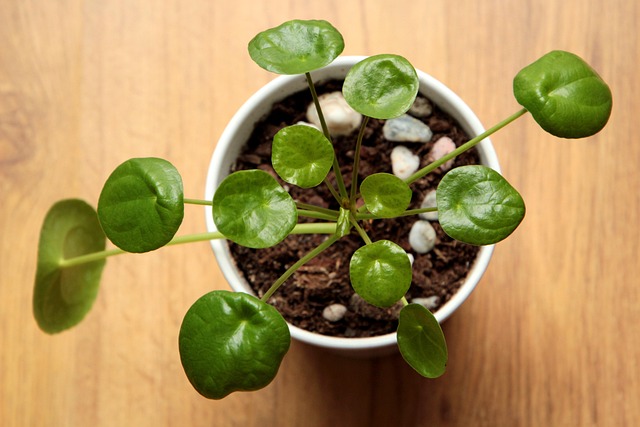
pilea peperomioides
Pilea peperomioides
Comprehensive care and diagnosis guide for the Pilea Peperomioides. Based on 6 verified community insights.
Care Requirements
At a Glance
Detailed care profile is currently being compiled by the Plant Grail swarm.
Start Here
Most Common Problems
Based on 6 analyzed cases — these are the issues you're most likely to encounter
What are these brown spots on my Pilea Peperomioides?
Direct sunlight exposure. Pilea peperomioides has thin, peltate leaves with an...
Why are my Pilea Peperomioides leaves turning yellow?
Natural aging process. Pilea peperomioides has a monopodial growth habit where...
How do I propagate my Pilea Peperomioides?
Pilea peperomioides produces basal offsets ('pups') via axillary bud...
Why does my Pilea Peperomioides have leaf curl?
Pilea peperomioides leaves curl upward (cupping) due to differential cell...
Why does my Pilea Peperomioides have symmetrical growth rotation?
Pilea peperomioides exhibits negative phototropism and photoelastic...
Verified Data
All Diagnoses
Complete analysis of 6 cases for this variety. Select an entry to expand rescue protocols.
Symptoms (1)
Common Questions
Frequently Asked Questions
Why does my pilea peperomioides have Brown spots?
Cause: Direct sunlight exposure. Pilea peperomioides has thin, peltate leaves with an underdeveloped cuticle that cannot handle the thermal load of direct UV rays, leading to rapid cell death (necrosis) appearing as black or brown spots.
Solution: Move the plant immediately to a location with bright indirect light (e.g., 2-3 feet away from a window or behind a sheer curtain).
Prevention: Avoid placing Pileas in south-facing windows without protection. Aim for 2000-5000 lux of indirect light.
90% confidence · View full protocol →
Why does my pilea peperomioides have Yellow leaves?
Cause: Natural aging process. Pilea peperomioides has a monopodial growth habit where it continuously produces new leaves from the crown while shedding the oldest leaves at the base to form its characteristic trunk. This is often accelerated when the plant is producing several pups (offsets).
Solution: Check the crown: if new leaves are coming in firm and green, the lower yellowing is normal.
Prevention: Expect 1-2 lower leaves to yellow and drop per month during active growth. This is a sign of a healthy, maturing plant, not a care error.
95% confidence · View full protocol →
Why does my pilea peperomioides have Pups propagation?
Cause: Pilea peperomioides produces basal offsets ('pups') via axillary bud proliferation at the rhizome crown. These genetically identical clones emerge when the mother plant reaches maturity (8-12 months) and has sufficient energy reserves. Pups develop their own rudimentary root systems while attached, allowing independent survival once separated. The plant's CAM photosynthesis (PMID 33287950) enables efficient energy storage for pup production even under suboptimal conditions.
Solution: Wait until pups reach 2-3 inches tall with 4-6 visible leaves and visible root nubs at the base
Prevention: Maintain mother plant in bright indirect light (1500-3000 lux) with 50-60% humidity to support vigorous pup production. Avoid over-fertilizing—excess nitrogen inhibits pup formation. Allow plant to become moderately root-bound (roots circling 60-70% of pot) as crowding stress triggers reproductive offsetting.
72% confidence · View full protocol →
Why does my pilea peperomioides have Leaf curl?
Cause: Pilea peperomioides leaves curl upward (cupping) due to differential cell elongation in response to light intensity gradients. The peltate leaf structure—where petiole attaches to center of leaf blade—creates unique biomechanical constraints (PMID 34893822). In low light, auxin redistribution triggers adaxial (upper) surface cell expansion, causing the leaf to cup upward to capture more photons. Direct sunlight causes photoinhibition and rapid transpiration, triggering similar curling as a protective response.
Solution: Diagnose cause: Gradual cupping = low light; sudden cupping with crispy edges = sun stress
Prevention: Maintain consistent bright indirect light (2000-3500 lux) without direct sun exposure. Rotate plant 90° weekly to ensure even light distribution across all leaves. Maintain 50-60% humidity to reduce transpiration stress. Position 3-5 feet from south-facing windows with sheer curtain filtration.
68% confidence · View full protocol →
Why does my pilea peperomioides have Symmetrical growth rotation?
Cause: Pilea peperomioides exhibits negative phototropism and photoelastic growth—leaves actively bend toward light sources within 24-48 hours. The petiole's torsional modulus allows 15-30° rotation daily. Without intervention, this creates asymmetric 'leggy' form with all leaves facing one direction and bare stems on the shaded side. The peltate leaf structure (PMID 34893822) maximizes light capture efficiency but requires frequent reorientation to maintain radial symmetry.
Solution: Rotate 90° every 3-4 days: Mark pot with cardinal directions (N, E, S, W) to track rotation schedule
Prevention: Implement 90° rotation protocol: Turn pot 90° clockwise every 3-4 days to distribute light exposure evenly around the plant's circumference. This mimics the multi-directional diffuse light of its native Chinese montane understory habitat.
70% confidence · View full protocol →