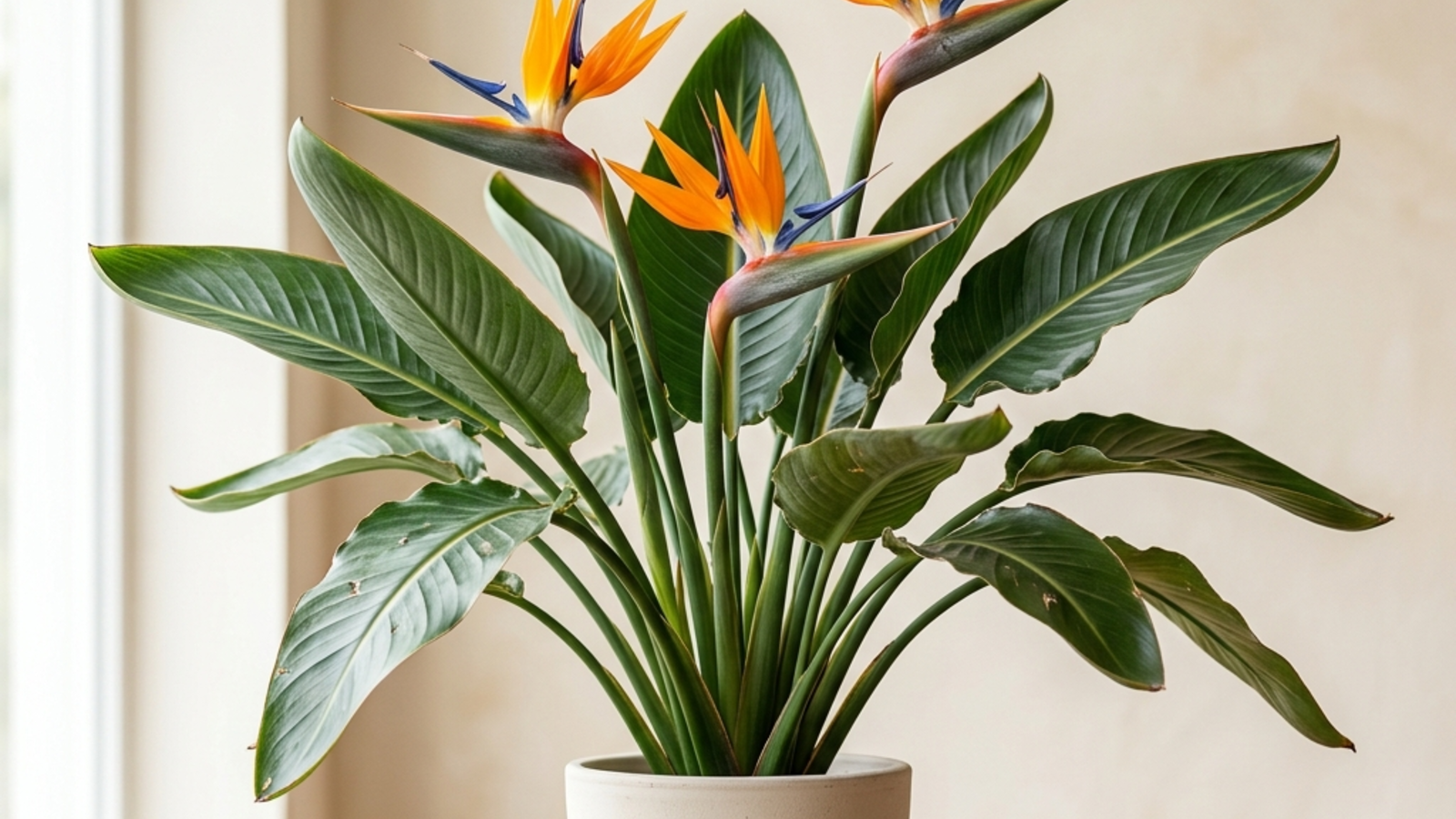
A bird of paradise is a big, sun-hungry plant that tolerates a lot, provided its roots are not kept wet. Clemson Extension notes that disease is rarely a problem in the home. The trouble usually comes from too much or too little water, too little light, or expecting flowers from a plant that is not old enough.
Two species are sold under the name: one stays a clump, the other becomes a tree.
Which bird of paradise do you have?
| Orange bird of paradise | White or giant bird of paradise | |
|---|---|---|
| Botanical name | Strelitzia reginae | Strelitzia nicolai |
| Flowers | Orange sepals and blue petals from a beak-like spathe (NC State) | White and blue, with a purplish-black bract (NC State) |
| Habit | Trunkless clump from underground rhizomes (NC State, Clemson) | Upright, with woody, clumping stems (NC State) |
| Size | 91 cm–1.2 m (3–4 ft) tall and wide (NC State); to 1.5 m (5 ft) (RHS, Clemson) | 6–9 m (20–30 ft) tall in its native habitat; leaves up to 2 m (6.5 ft) long (NC State) |
| Light listed | Full sun to partial shade (NC State) | Bright, indirect light; partial shade (NC State) |
The common names overlap. NC State lists “white bird of paradise” as a name for S. nicolai. Clemson uses “white” for Strelitzia alba and “giant” for S. nicolai. Keep the nursery label. A small S. nicolai will not stay small, so plan for its height and leaf spread. Our large indoor plants guide compares floor plants by light and size.
For a side-by-side look at size, flowers and indoor space, see Strelitzia reginae vs nicolai.
Care at a glance
| Factor | What the sources say |
|---|---|
| Light | Well-lit, sunny spot (NC State). Full sun, or at least a south window (Clemson). Shade from hot sun under glass (RHS) |
| Water | Wet the mix thoroughly, then let it dry slightly (Clemson). Water freely in growth, sparingly in winter (RHS) |
| Mix | Fertile, loamy, well-drained (NC State). Peat-free, loam-based compost (RHS) |
| Temperature | 18–21 °C (65–70 °F) by day and 10–13 °C (50–55 °F) at night (Clemson). Night 13–18 °C (55–65 °F) (NC State) |
| Humidity | Moderate, around 60 percent (Clemson). S. nicolai prefers high humidity (NC State) |
| Feeding | Spring and summer only (Clemson, NC State). Monthly during growth (RHS) |
| Repotting | Top dress every year, repot every second year (RHS) |
| Pets | Toxic to dogs, cats and horses (ASPCA) |
Light: the factor that decides flowering
NC State says to grow S. reginae indoors in a well-lit, sunny spot. Clemson says it prefers full sun but will tolerate lower light, such as a south-facing window. The RHS recommends full light with shade from hot sun when it is grown under glass.
For S. nicolai, NC State lists bright, indirect light. If you move either plant into stronger sun, do it gradually and watch the newest leaves.
Watering through the year
NC State says to water S. reginae freely in spring and summer and keep it drier in winter. Clemson gives the method: wet the potting mix thoroughly, then let it dry slightly before watering again. Water less often in the colder months, when light is lower.
For S. nicolai, NC State says to water when the top layer of soil feels dry. Once established, the plant becomes more drought tolerant.
Both extremes show in the leaves. UF IFAS says dry or soggy conditions make the leaves yellow and eventually die. The pot tells you which one you have. Lift it or feel below the surface before you water again.
In a decorative outer pot, empty any water that collects. Our watering guide covers the checks for heavy pots.
Temperature, humidity and summers outdoors
Clemson gives 18–21 °C (65–70 °F) during the day and 10–13 °C (50–55 °F) at night. NC State gives night temperatures of 13–18 °C (55–65 °F). For S. nicolai, NC State prefers 18–29 °C (65–85 °F) and says it will not tolerate temperatures below 10 °C (50 °F). Avoid cold drafts.
Clemson suggests moderate relative humidity, around 60 percent. For S. nicolai, NC State suggests a tray of wet pebbles or a humidifier. See our humidity guide.
A summer outside can help. NC State says to move the plant to a sunny or semi-shaded spot with good air circulation once outdoor temperatures rise above 21 °C (70 °F). Clemson says to bring it back indoors when temperatures begin to drop below 16 °C (60 °F).
Mix, pot and repotting
NC State recommends fertile, loamy, well-drained soil. The RHS advises a peat-free, loam-based compost in a large container. It suggests top dressing every year and repotting every second year.
Do not rush to a much bigger pot. The RHS says plants generally flower better when slightly pot-bound.
University of Maryland Extension advises against a gravel layer in the bottom of the pot. After repotting, water thoroughly, then wait until the top of the mix dries.
Feeding
The sources agree on the season but not the frequency:
- Clemson: every 2 weeks in spring and weekly in summer, with no fertilizer in autumn or winter.
- RHS: a balanced liquid fertilizer monthly during growth.
- NC State (S. nicolai): a balanced liquid fertilizer once a month in spring and summer.
Follow the product label. Clemson warns that overfeeding leads to lots of leaves with little or no flowering. Our fertilizer schedule explains how to spot and flush salt buildup.
Why it is not flowering yet
Age is the most common answer. The RHS says plants may take a few years to bloom, and will flower only with adequate light and feed. Clemson says divisions should flower in two to three years. Plants grown from seed can take four to ten years or more. NC State says S. nicolai may take 5 to 6 years.
Work through these checks in order:
- Age. A young plant from a small pot may not be mature yet.
- Light. The RHS says it flowers only with adequate light. Move it to your brightest spot.
- Pot size. The RHS says it flowers better slightly pot-bound.
- Feeding. Lots of new leaves and no flowers can mean too much fertilizer (Clemson).
- Season. Clemson says flowers open in succession from late winter or early spring. NC State says S. reginae blooms intermittently through the year.
Split, yellow or damaged leaves
NC State notes that S. nicolai leaves rip along their veins in wind, and says to remove ripped or torn leaves. A clean split on a firm, green leaf is physical damage, not disease.
| What you see | What to check first |
|---|---|
| Clean splits along the veins | Wind (NC State) or knocks |
| Yellow leaves, dry light pot | Underwatering (UF IFAS) |
| Yellow leaves, wet heavy pot | Overwatering or poor drainage; check the roots |
| Yellow or brown spots on firm leaves | Leaf spot (NC State) |
| Speckling, webbing, sticky residue or cottony tufts | Spider mites, scale, mealybugs, aphids or whiteflies (NC State, Clemson, RHS) |
Inspect the undersides of leaves before you spray anything. Our spider mite guide and houseplant pest guide cover identification and treatment.
Root rot
NC State says root rot can occur from overwatering or poorly drained soils. Clemson says it usually follows a mix that does not drain quickly or overly frequent watering.
University of Maryland Extension describes the signs. Leaves yellow, brown and die back, and the plant can wilt even when the mix is moist. Rotted roots are brown to black and soft. If your plant is wilting in wet mix, follow our bird of paradise root rot guide to inspect, trim and repot. For the causes in general, see our root rot guide.
Propagation by division
Clemson says to divide the rhizomes in early spring, before new growth begins. Cut so each division has a fan of leaves with roots attached. Keep each potted division warm in bright, indirect light for eight weeks, then move it to bright sunlight. UF IFAS says to replant divisions at the depth they grew before.
Is bird of paradise safe for pets?
No. The ASPCA lists Strelitzia reginae as toxic to dogs, cats and horses. The toxins are gastrointestinal irritants that cause mild nausea, vomiting and drowsiness, mainly from the fruit and seeds. The ASPCA notes that a different plant, Caesalpinia gilliesii, is also called bird of paradise and is more toxic.
NC State lists S. nicolai as toxic to people, dogs, cats and horses, and advises gloves when handling it. See our pet-safe plants guide.
References
- NC State Extension Gardener Plant Toolbox: Strelitzia reginae
- NC State Extension Gardener Plant Toolbox: Strelitzia nicolai
- Clemson Cooperative Extension HGIC, C. Burgess: Bird of Paradise
- University of Florida IFAS Extension MG106, S. Park Brown and R. J. Black: Bird-of-Paradise
- University of Florida IFAS Extension FPS-563, E. F. Gilman, R. Klein and G. Hansen: Strelitzia reginae, Bird of Paradise
- Royal Horticultural Society: Strelitzia reginae
- University of Maryland Extension: Root Rots of Indoor Plants
- University of Maryland Extension: Potting and Repotting Indoor Plants
- ASPCA Animal Poison Control Center: Bird of Paradise Flower