A dark apartment is a layout problem before it is a product problem. One plant beside a sofa, a long bookcase, and a dense propagation shelf need different beams, mounting methods, and power.
The strongest setup is the smallest documented fixture that covers the actual leaves without creating glare, heat, unsafe cords, or an awkward permanent installation.
Choose by apartment zone
| Apartment zone | Useful format | Why it fits | Main risk |
|---|---|---|---|
| One tabletop plant | Screw-in white grow bulb in a stable lamp | Low-cost, movable, familiar socket | Beam misses leaves when lamp is too far away |
| Long shelf | Linkable LED bars | Even coverage along a narrow canopy | Top shelf may block lower plants |
| One floor plant | Pendant or adjustable floor fixture | Directs light onto a tall visible canopy | Glare and insecure mounting |
| Dense plant corner | Dimmable panel | Covers a rectangular group efficiently | Too much center intensity |
| Propagation rack | Bars or shop-light format | Repeatable shelf spacing | Water and cord management |
For current fixture examples and the specifications worth comparing, use the grow-light buying guide.
First decide whether the room is truly low light
Do not judge from wall color or how bright the room feels. Measure at the leaves. A large bright window can still deliver little usable light to a plant across the room, especially behind a balcony, tree, tinted glass, or neighboring building.
Use the indoor window-light guide to assess direction, obstruction, season, and distance. Penn State Extension recommends using a light meter as a guideline and then reading the plant. That combination is more reliable than a room label.
Match plants before adding hardware
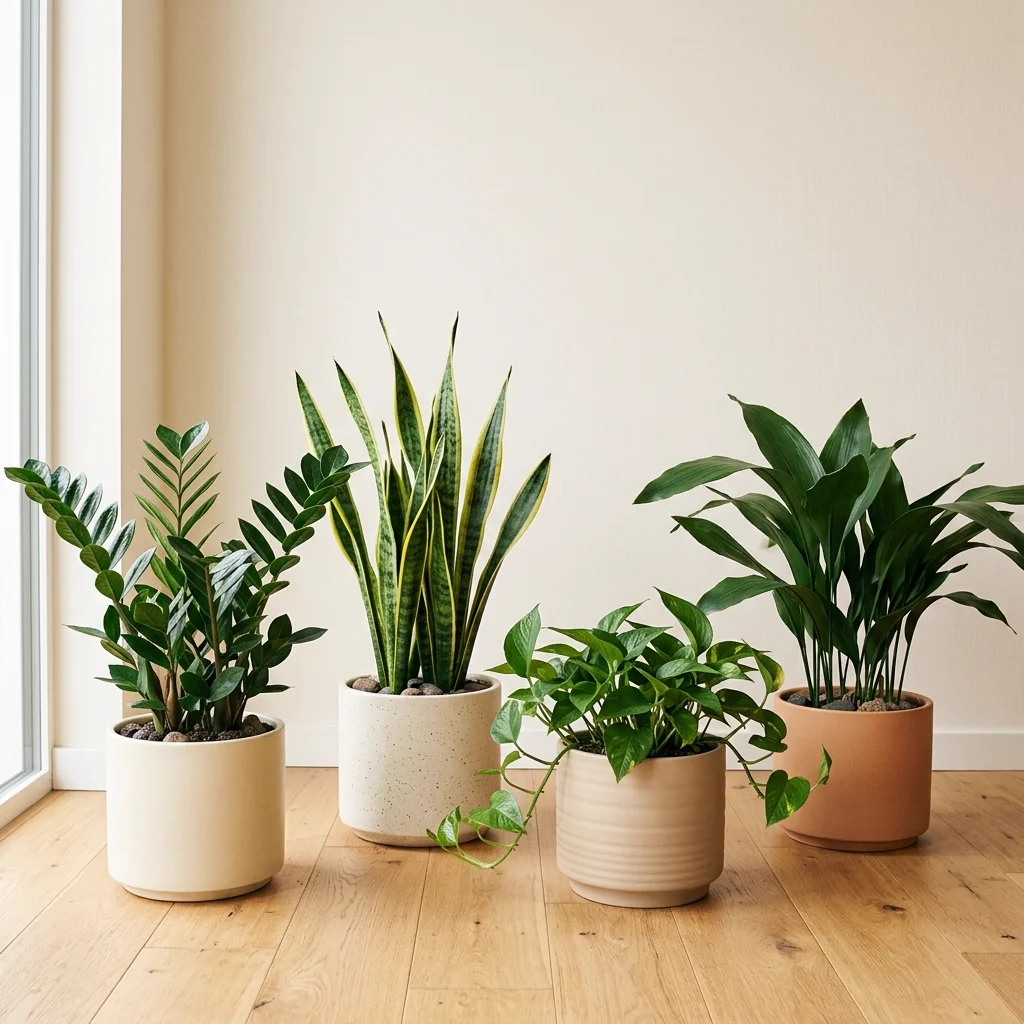
If the only available location is dim, start with low-light-tolerant plants such as ZZ plant, snake plant, pothos, cast iron plant, peace lily, or Chinese evergreen. They still require light, but they tolerate lower levels than citrus, herbs, succulents, and many flowering plants.
The 50+ houseplant light chart separates low-, medium-, and high-light groups. A modest bulb may support one pothos; it may not keep a citrus tree productive.
Setup 1: one plant in a living area
A white screw-in grow bulb is the simplest apartment format when:
- the plant canopy fits within the beam;
- the lamp can point directly at the foliage;
- the socket and shade are compatible with the bulb;
- the stated distance is practical;
- the visible color is comfortable in the room.
GE’s official BR30 grow-bulb page, for example, publishes actual wattage, PPF, socket type, spectrum description, and a close placement recommendation. The value is not the brand name; it is that the specifications let you judge fit.
Avoid a decorative lamp that points most light at the wall or ceiling. A bright room is not the same as a lit canopy.
Setup 2: a plant shelf
Bars suit shelves because their shape follows a long narrow canopy. Install one or more bars so that:
- every plant remains inside the useful footprint;
- short plants are raised rather than left far below the light;
- tall plants cannot grow into the fixture;
- cords have drip loops and stay outside watering paths;
- each shelf receives light rather than relying on spill from above.
Measure center and ends. If the center is strong and the ends are weak, another bar or a different spacing pattern is usually better than lowering one small source.
Setup 3: a visible floor plant
A pendant or adjustable floor light can illuminate Monstera, fiddle-leaf fig, bird of paradise, or another large plant without turning the room into a propagation rack.
Prioritize:
- a published beam angle or coverage guide;
- PPFD values at realistic room distances;
- dimming;
- warm or neutral white appearance;
- secure mounting;
- a timer;
- glare control from seated eye level.
Soltech’s current Aspect Gen 2 page is one example of a decorative fixture that publishes wattage, PPF, dimming, beam angle, and PPFD at several distances. Treat those as manufacturer claims and verify the exact version before purchase.
Setup 4: a dense plant corner
A panel works when plants occupy a concentrated rectangle and the area is dedicated to growing. It may be excessive for one shade-tolerant plant.
Use a dimmable model, compare the PPFD map at your available hanging height, and group plants with similar needs. A high center value does not fix dark outer pots. Arrange taller plants at the edge only if their leaves remain within the documented footprint.
Control glare, sleep, and daily routine
Apartment lighting affects people as well as plants.
- Use a timer so the light does not depend on memory.
- Schedule bright fixtures during daytime or when the room is occupied.
- Preserve a dark period for plants.
- Use white balanced light in living spaces when purple glare is disruptive.
- Shield direct view of high-output diodes.
- Do not place bright plant lighting where it disrupts sleep.
The distance and duration guide provides starting schedules for foliage plants, flowering plants, and seedlings.
Calculate the operating cost
Use actual wall wattage:
monthly kWh = watts / 1000 x hours per day x 30
Multiply by your electricity price. Compare setups that cover the same canopy. One efficient panel can still waste energy if most of its beam misses the plants; several weak bars can cost more than a correctly sized fixture.
Do not rely on “equivalent watts.” Watts describe electricity use, while PPF and PPFD data describe plant-light output and distribution.
Renter-friendly installation checklist
- Confirm fixture weight and the maker’s mounting instructions.
- Prefer stable floor lamps, stands, shelf hardware, or load-rated removable systems.
- Keep cords out of walkways and away from standing water.
- Do not cover power supplies or trap heat behind furniture.
- Use the correct socket and electrical rating.
- Photograph the setup and record distance and timer hours.
- Recheck mounting after moving plants or adjusting height.
For heavy overhead equipment or uncertain wiring, use a qualified installer rather than improvising.
Read the apartment plants
Too little usable light often produces leaning, longer internodes, smaller new leaves, lost variegation, and very slow drying. Too much or abrupt light can produce bleaching, exposed tan patches, warm leaves, and upward cupping.
Change one variable at a time. If soil remains wet for much longer after a seasonal light decline, adjust watering from root-zone evidence rather than a fixed calendar.
Bottom line
Small apartments do not need one universal “apartment grow light.” Use a bulb for one plant, bars for shelves, a pendant for a visible floor plant, and a panel for a dense dedicated zone. Measure at the leaves, keep the installation safe, use a timer, and buy only enough documented coverage for the canopy you have.