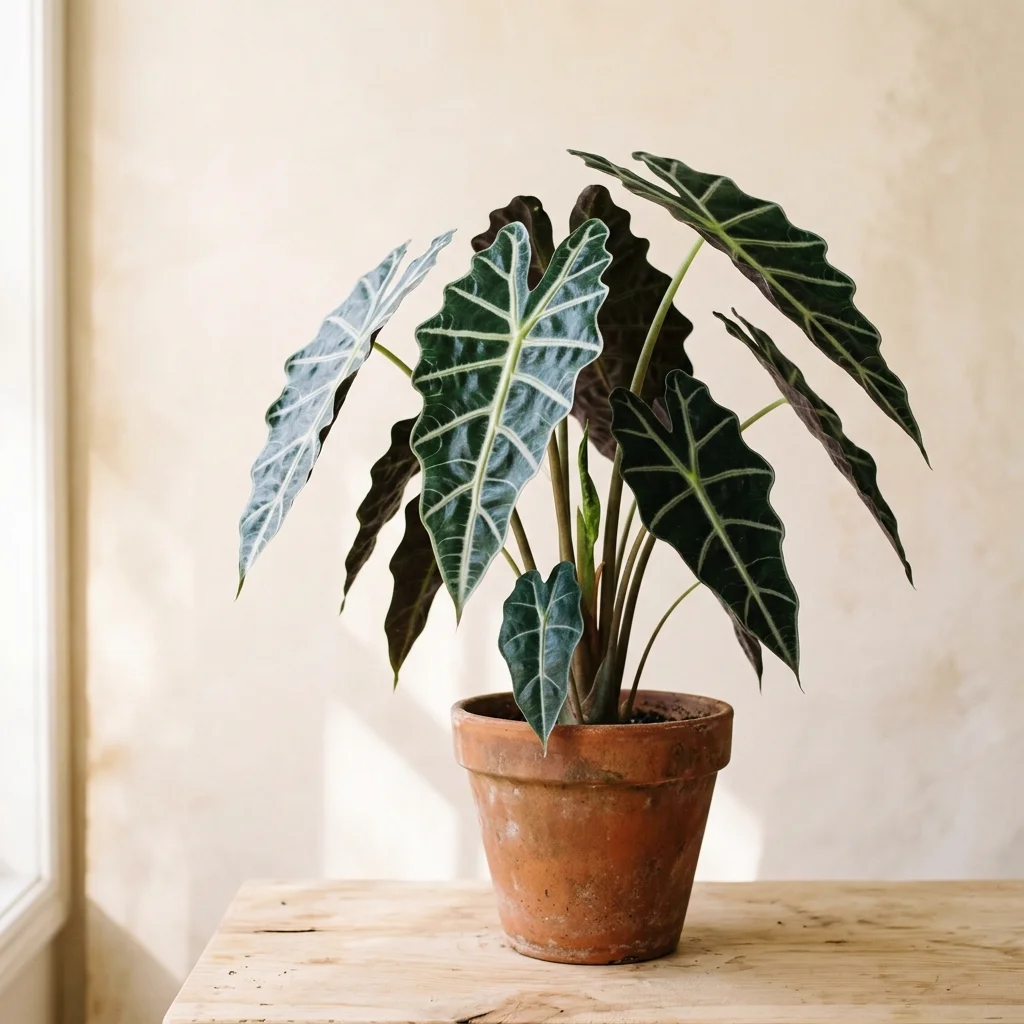
Monstera, Alocasia, and Pothos are all aroids, but they do not create the same lighting problem. Monstera becomes a tall climbing canopy, Alocasia holds leaves on upright petioles, and Pothos trails or climbs beyond the pot. One fixture can serve them only when its coverage follows the leaves.
Use plant class as the starting point, then solve canopy geometry.
The practical differences
| Plant | Extension light class | Canopy behavior | Setup priority |
|---|---|---|---|
| Pothos | Low-light tolerant; brighter filtered light supports variegation and mature growth | Trails or climbs outside the pot | Cover the vine, not only the container |
| Monstera deliciosa | Medium light | Climbs and develops a broad upper canopy | Support height, leaf spacing, and even top coverage |
| Alocasia | Medium light | Upright leaves can sit at different angles and heights | Avoid a hot center directly over one leaf |
University of Minnesota Extension lists pothos among low-light plants and Monstera and Alocasia among medium-light plants. North Carolina Extension notes that pothos prefers bright indirect light while surviving lower light, and that low light can reduce variegation. Its Monstera guidance describes moderate brightness without direct sunlight and notes that variegated cultivars need more light than green forms.
These categories are more defensible than assigning every cultivar one exact lux target.
One-fixture layout
For a shared rectangular growing area:
- Put Monstera and Alocasia beneath the stronger central or documented medium-light zone.
- Place Pothos near an outer area only if that edge still receives useful measured light.
- Raise short pots so leaf height is not far below the others.
- Train Pothos upward or along the lit shelf instead of letting foliage trail into darkness.
- Keep the Monstera support from shading Alocasia leaves.
- Measure center and corners at leaf height.
A dimmable panel can work for a dense group. Bars can work across a long shelf. A pendant is better for one concentrated tall plant than for three pots spread across a wall.
Use the grow-light buying guide to compare fixture formats.
Monstera setup
Monstera deliciosa is an understory climber suited to medium indoor light. More usable light does not automatically create fenestrations; maturity, climbing support, genetics, root health, and overall growth also matter.
Position the fixture so new leaves receive even light without one leaf blocking the rest. As the plant climbs, either raise the light within the fixture’s documented range or add side coverage. A ceiling source can leave lower leaves in deep shade.
Watch for:
- increasingly long petioles aimed at the source;
- smaller new leaves;
- wider gaps between nodes;
- a strongly one-sided canopy;
- variegated growth losing contrast.
Bleached upper surfaces or tan patches after moving the light closer suggest excess intensity or poor acclimation.
Continue with the Monstera care guide for support, watering, and root-zone decisions.
Alocasia setup
Alocasia leaves face different directions and can place one blade much closer to the fixture than the others. Measure at the highest leaf, then check lower leaves and corners.
Avoid solving weak lower coverage by placing one powerful source extremely close to the tallest leaf. Raise or widen the setup, use dimming, or separate plants by height.
Watch for:
- petioles leaning hard toward the source;
- a new leaf that is smaller than the previous one;
- rapid yellowing while the root zone stays wet;
- pale fixture-facing patches;
- edge browning after an abrupt increase.
Light and watering interact. A winter Alocasia under weak light can use water slowly; a stronger setup can change drying time. Check the mix instead of preserving the old calendar.
The Alocasia complete care guide covers temperature, roots, moisture, and dormancy alongside light.
Pothos setup
Pothos tolerates lower light but usually grows fuller in brighter filtered conditions. A trailing vine often escapes a small beam even when the pot appears well lit.
Choose one of three strategies:
- train vines upward on a support inside the footprint;
- run bars along the shelf or wall followed by the vines;
- prune and propagate long bare sections, then improve coverage for new growth.
Watch for:
- long spaces between leaves;
- smaller leaves farther from the fixture;
- loss of variegation;
- vines leaning toward a window outside the setup;
- soil staying wet while growth slows.
The Pothos complete care guide connects light with watering, soil, and pest checks.
Variegated aroids
Variegated leaves contain less green photosynthetic tissue, but pale areas also lack the protection of fully green tissue. The safe response is gradual adjustment, not an extreme close distance.
- Begin from a documented medium-light setup.
- Increase output or reduce distance in small steps.
- Hold watering and fertilizer decisions steady.
- Inspect only the next leaves for improvement.
- Back off if pale tissue develops exposed tan or bleached areas.
Do not use variegation alone as a light meter. Genetics can influence pattern from leaf to leaf.
Distance and timer
University of Minnesota Extension gives 12 to 24 inches and 12 to 14 total light hours as broad starting guidance for foliage houseplants. Your fixture may require a different height.
Use the distance and duration guide to combine maker data, PPFD distribution, canopy measurements, and darkness. Do not run a weak source continuously.
Diagnose the setup
| Observation | Check first | Likely adjustment |
|---|---|---|
| Monstera top grows, lower leaves decline | Vertical coverage and self-shading | Add side light or reorganize support |
| One Alocasia leaf bleaches | Highest-leaf distance and center intensity | Raise or dim gradually |
| Pothos loses leaves along a trailing vine | Whether the vine exits the footprint | Extend bars or train upward |
| All three lean the same direction | Window contribution and fixture position | Center coverage over actual leaves |
| Soil stays wet much longer | Seasonal light decline and root condition | Improve usable light and reassess watering |
| Only center plants grow | Edge PPFD or lux comparison | Widen coverage or add another source |
Light symptoms overlap with root damage and pests. Inspect the root zone and leaf surfaces before blaming intensity alone.
Bottom line
Pothos, Monstera, and Alocasia can share a grow light when they share a measured canopy. Group by height, give medium-light plants the stronger zone, keep Pothos vines inside the footprint, acclimate variegated tissue, and use new growth to verify the result.