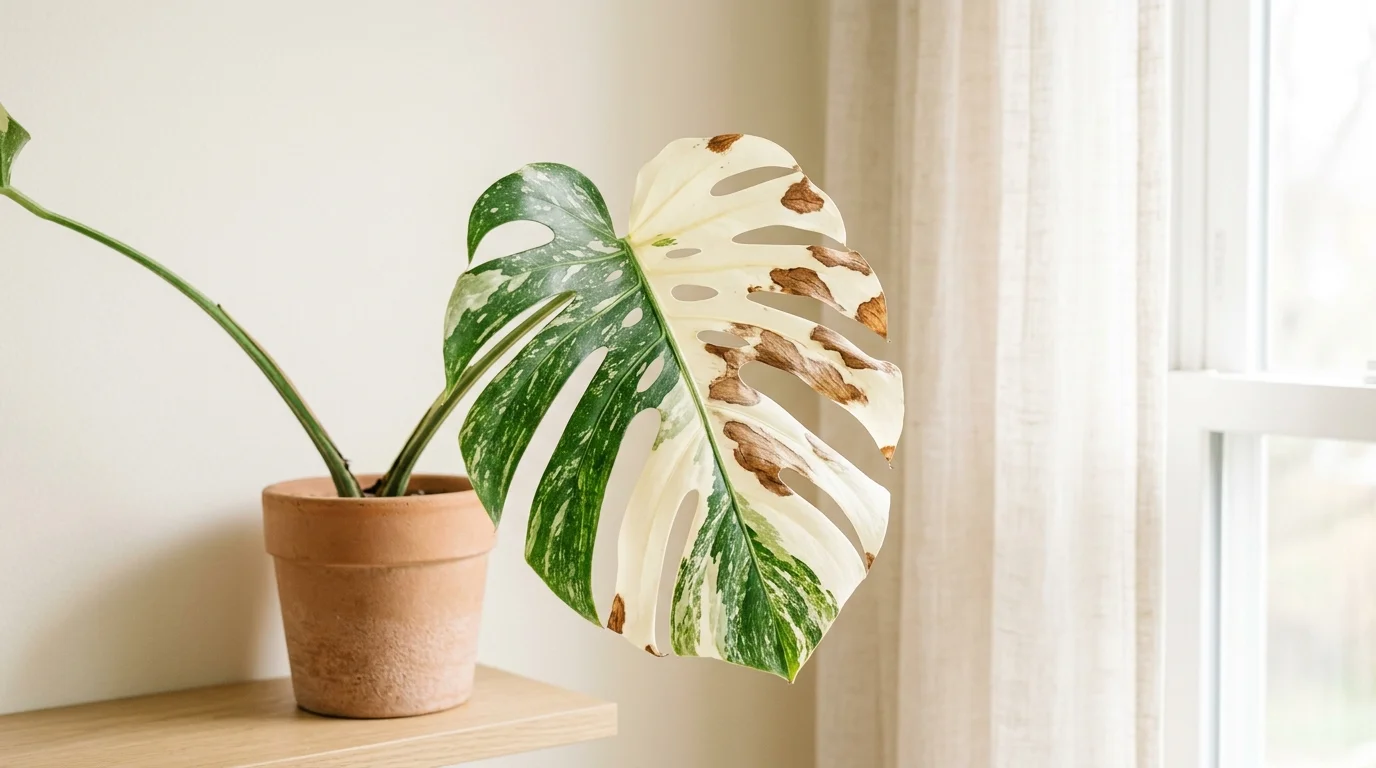
A brown patch on a cream ‘Thai Constellation’ leaf is upsetting, because these plants are not cheap. The reassuring part: this is still a Monstera deliciosa, and most of its problems are the species’ problems. The difference is the pale tissue, which makes less food and shows damage more clearly.
Most of the advice below comes from sources written for Monstera deliciosa or houseplants in general. Where that matters, we say so.
What ‘Thai Constellation’ is
NC State Extension lists ‘Thai Constellation’ as a cultivar of Monstera deliciosa with a “pattern of marbled and speckled creamy white and green variegation, resembling a constellation”. The RHS describes it as a tropical evergreen climber, slightly slower growing than the species, with leaves more closely spaced. Mature leaves are heart-shaped, deeply cut and often perforated, deep green splashed and streaked with creamy white.
University of Minnesota Extension explains where the pattern comes from. Variegated forms such as ‘Thai Constellation’ carry mutations that change the amount of chlorophyll in parts of the leaf. With less chlorophyll, the plant captures energy more slowly than a green Monstera and grows more slowly. Some of these mutations last for the plant’s life. Others are unstable, and green growth can outgrow the variegation.
None of the extension or RHS pages we read describe how the cultivar originated, so we leave origin stories out. If all-green leaves start to appear, see variegated Monstera reverting to green.
Light for variegated leaves
NC State recommends moderate brightness but not direct sunlight for Monstera deliciosa, and says variegated cultivars need more light than darker green ones. The RHS recommends bright, indirect light with moderate to high humidity for ‘Thai Constellation’. Missouri Botanical Garden gives the species bright indoor light with no strong direct sun.
Both halves of that advice come back to the cream sectors. They make less food, so a dim corner slows the plant further (Minnesota). And University of Maryland Extension says strong sun and heat break down chlorophyll, leaving pale, bleached areas that turn brown and brittle.
- Bright window, no hot direct sun. Maryland suggests more distance from the glass or a sheer curtain in strong summer sun.
- Increase light in steps. Maryland advises starting with short periods of sun and lengthening them gradually.
- Grow light for dark rooms. University of Missouri Extension calls lack of light the most common factor limiting houseplant growth indoors.
Our variegated Monstera light guide covers placement in more detail.
Watering and mix
NC State says to water Monstera deliciosa thoroughly, then let the top quarter to one-third of the mix dry before watering again. For ‘Thai Constellation’, the RHS recommends a peat-free, loam-based potting compost. Water while it is growing, keep it just moist in winter, and feed with a balanced liquid fertiliser monthly during growth.
Virginia Tech’s watering guide adds that overwatering is about how often you water, not how much. Soak the whole root ball, let it drain, and do not leave the pot standing in water for more than 60 minutes. Avoid a pot that is too large, because the extra mix stays wet around the roots.
Brown spots on the white and cream sections
Maryland Extension lists water spots, sunburn, fungi and bacteria as causes of leaf spots and blotches on indoor plants, so check the pattern before you treat anything.
| What you see | Points to | Source |
|---|---|---|
| Pale or bleached patches that go brown and papery, on the side facing the window, after a move or a sunny spell | Sun scorch; worse when the mix was also dry | Maryland Extension |
| Small brown spots with yellowish margins, sometimes in rings, with tiny black dots | Fungal leaf spot | Clemson HGIC |
| Water-soaked spots, sometimes with a yellow halo or sticky ooze; reddish-brown specks when dry | Bacterial leaf spot | Clemson HGIC |
| Raised, crusty or corky bumps on the underside that turn brown | Edema: roots taking up more water than the leaves lose | Maryland Extension, Clemson HGIC |
| Brown, dry tips and edges | Hot dry air, irregular watering, insect feeding or salt build-up | Clemson HGIC, Virginia Tech |
| White or straw-coloured patches after watering | Cold water spots | Clemson HGIC |
| Fine speckling, webbing or scale insects | Pests; the RHS lists scale and glasshouse red spider mite for this cultivar | RHS, Missouri Botanical Garden |
The cream tissue already holds less chlorophyll, which is why sun damage there is a real concern (Minnesota, Maryland). No source we found measures how ‘Thai Constellation’ sectors respond to sun, so blame scorch only when damage follows a clear increase in light.
- Sun scorch: move the plant back from the glass or add a sheer curtain, and do not let the mix dry out completely.
- Fungal or bacterial spots: Clemson recommends removing infected leaves, improving air circulation and keeping water off the foliage.
- Edema: Maryland says to allow more drying time between waterings, especially when the mix is cool and the air warm. Clemson adds better light. Monstera is not on Maryland’s list of edema-prone plants, so treat this as a general check.
- Brown tips: Clemson suggests leaching salts with an occasional heavy watering, emptying the saucer and not overfertilising.
Clemson notes that leaves with edema will not recover, so judge your fix by the next leaves. Our Monstera brown spots guide covers the same checks for green plants.
Yellow leaves: one old leaf or the roots?
None of our sources give a “normal” rate of leaf loss for this cultivar. University of Maryland Extension says yellowing is often the first sign of stress, overwatering is the main reason indoor plants fail, and the pattern of symptoms points to the cause.
- Several leaves, old and new, with wet mix. Virginia Tech lists yellowing on both new and old foliage, mushy leaves and stems, a rotten-smelling mix and fungus gnats as overwatering signs; check the roots.
- Only the lowest leaves, mix drying normally. Clemson links yellowing and browning of the lower leaves to nitrogen or iron shortage, with pot-bound plants most at risk. It adds that lower leaves can yellow after a long dry spell.
- Pale new growth in a dim spot. Clemson lists too little light among the causes of yellowing.
For more, see Monstera yellow leaves and Monstera watering: thirst or wet mix?.
Root rot after shipping or repotting
No source covers shipped ‘Thai Constellation’ plants, so general root-rot guidance applies. Maryland Extension advises inspecting newly bought plants before putting them near others. Clemson notes that some leaf drop follows a major change in environment and should last only about three weeks.
Root rot looks different. Maryland lists yellowing and dieback of leaves, dark, soft roots, and wilting even when the mix is moist.
- Slide the plant out and look. Minnesota describes healthy Monstera roots as creamy white and firm. Brown, soft roots point to overwatering or poor drainage.
- Trim the damage. Clemson says that if only a few roots are infected, cut them out and repot in sterile mix.
- Use a clean pot and fresh mix. Maryland recommends clean or new pots and sterile media. Virginia Tech warns that an oversized pot keeps roots too wet.
- Take a cutting if the base is lost. Maryland says to take stem cuttings only from healthy tissue. Minnesota says a cutting must include a node; a leaf on its own will not grow and will rot.
Related guides: Monstera root rot, why Monstera roots need air and Monstera transplant shock.
Root rot in LECA or semi-hydro
LECA does not stop root rot. Minnesota Extension values it for cuttings because it drains so well. The RHS guide to hydroponics says the root zone must stay moist, supplied with nutrients and very well aerated. It suggests replacing nutrient solutions every two weeks or so, because they can become too concentrated.
Virginia Tech advises cleaning water reservoirs regularly to prevent waterborne diseases and algae. If roots in LECA turn soft and dark, the Maryland and Clemson steps above still apply: remove decayed roots, clean or replace the container and aggregate, and isolate the plant. None of these sources covers ‘Thai Constellation’ in LECA. If you cannot keep up with the reservoir, potting mix may be simpler. Our LECA vs potting mix comparison sets out what each system asks of you.
Is ‘Thai Constellation’ safe for pets?
No. The ASPCA lists Monstera deliciosa as toxic to dogs and cats. Its insoluble calcium oxalates cause oral irritation, burning of the mouth, tongue and lips, drooling, vomiting and difficulty swallowing. The RHS lists ‘Thai Constellation’ as harmful if eaten and a skin and eye irritant, so wear gloves when you prune. For everyday care of the species, see our Monstera deliciosa care guide.
References
- NC State Extension Gardener Plant Toolbox: Monstera deliciosa
- Royal Horticultural Society: Monstera deliciosa ‘Thai Constellation’
- University of Minnesota Extension, N. Burley and J. Weisenhorn: Propagating Monstera deliciosa
- Missouri Botanical Garden Plant Finder: Monstera deliciosa
- University of Maryland Extension: Excess Light on Indoor Plants
- University of Maryland Extension: Lighting for Indoor Plants
- University of Maryland Extension: Edema of Indoor Plants
- University of Maryland Extension: Yellowing Leaves on Indoor Plants
- University of Maryland Extension: Root Rots of Indoor Plants
- University of Maryland Extension: Diagnose Indoor Plant Problems
- Clemson Cooperative Extension HGIC 2251: Houseplant Diseases & Disorders
- Virginia Cooperative Extension SPES-804, K. S. Criscione and A. Holliday-Goulart: Properly Watering Container Houseplants
- Royal Horticultural Society: Hydroponics
- University of Missouri Extension G6515, D. H. Trinklein: Lighting Indoor Houseplants
- ASPCA Animal Poison Control Center: Cutleaf Philodendron (Monstera deliciosa)