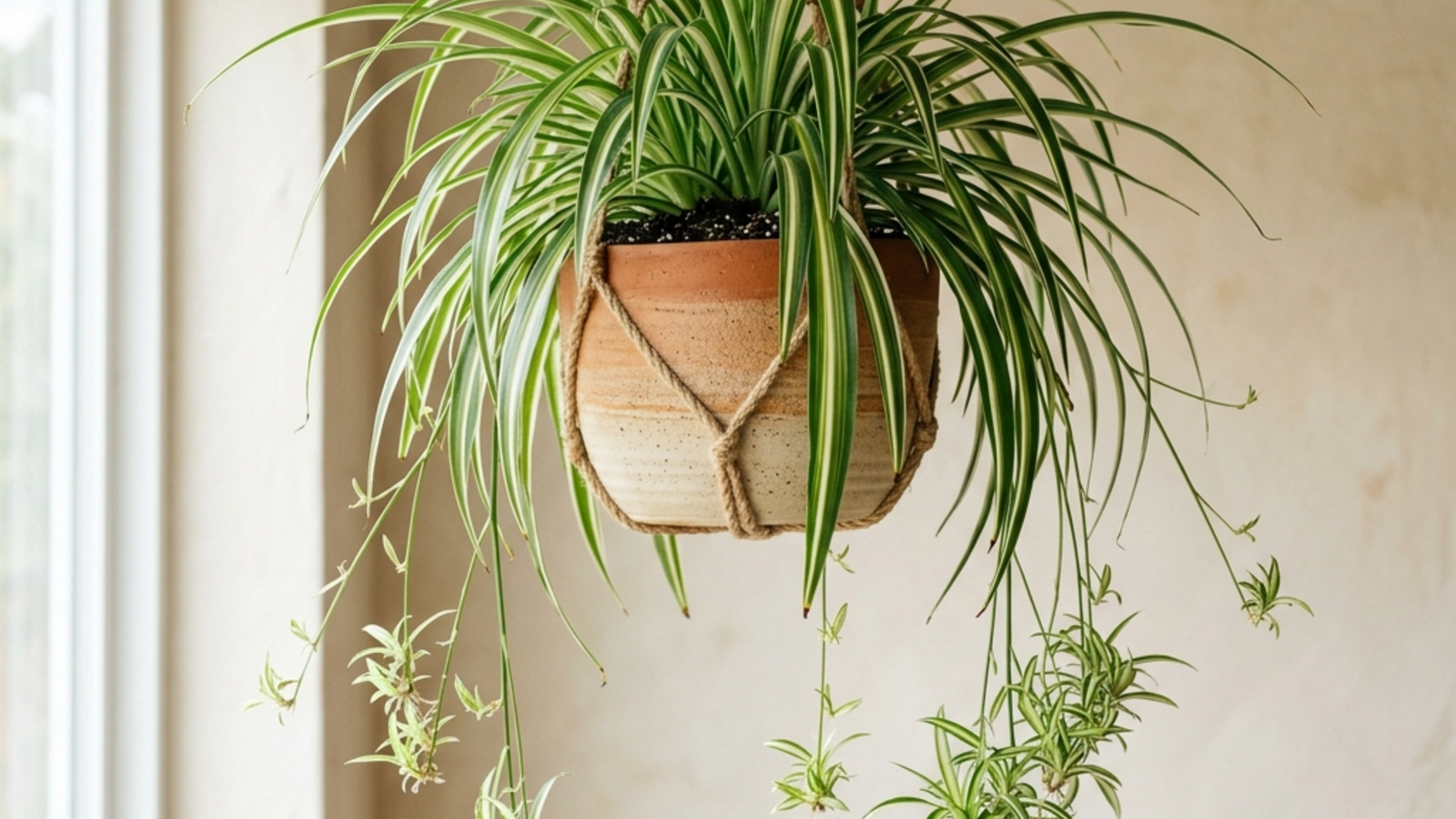
Spider plant is one of the most forgiving houseplants you can grow. UW–Madison Extension describes it as tolerant of neglect, and its thick, fleshy roots store water through missed waterings. When something does go wrong, it is usually cosmetic: brown leaf tips, faded stripes, or a mature plant that refuses to make babies. Each has a specific cause you can check.
This guide covers Chlorophytum comosum, an herbaceous perennial in the asparagus family (Asparagaceae). NC State Extension gives its native range as tropical West Africa to Cameroon and Ethiopia to South Africa. It grows 30–46 cm (1–1.5 ft) tall and 30–61 cm (1–2 ft) wide.
Spider plant care at a glance
| Factor | What the sources say |
|---|---|
| Light | Medium light; tolerates deep shade; no direct sun (NC State). Bright but indirect is best (RHS) |
| Water | Let the mix dry slightly between thorough waterings (UW–Madison); keep it lightly moist, never standing in water (RHS) |
| Winter | Water less while growth slows (NC State, RHS) |
| Temperature | Above 7 °C (45 °F) (NC State) |
| Humidity | Average is fine; very dry air can brown tips (RHS) |
| Water quality | Fluoride and chlorine in tap water can cause tip burn (NC State) |
| Feeding | Every 3–4 months, or more often at half strength (UW–Madison). Over-feeding reduces plantlets (NC State) |
| Repotting | Every year or two into a slightly larger pot (RHS) |
| Propagation | Plantlets or division (NC State) |
| Pets | Non-toxic to dogs and cats (ASPCA) |
Light
NC State says spider plant prefers medium light, can tolerate deep shade, and is intolerant of direct sunlight. University of Missouri Extension agrees that it tolerates low light but grows best in the medium range. UW–Madison puts it in medium to bright light all year.
The RHS explains what happens at either end. In low light, growth slows and leaves may lose their variegation. In strong sun, leaves can turn yellow or brown, and variegated cultivars scorch in hot, bright spots. An east window, or a spot set back from a south or west window, suits it.
The RHS adds one useful check: yellowing leaves on a spider plant usually mean too little light, not a lack of nutrients. Move the plant somewhere brighter before reaching for fertilizer.
Watering
UW–Madison advises letting the soil dry slightly between thorough waterings. The RHS says to keep the compost lightly moist and never let the pot stand in water. Pour away what collects in the saucer.
- Thirst signs. The RHS notes that pale, dull leaves usually mean the plant needs more water. University of Maine Extension suggests watering when the mix is dry an inch or more down, or when the pot feels light.
- Too much water. UW–Madison warns that overwatering or poorly drained soil leads to root rot. See our spider plant root rot guide if the base feels soft.
- Winter. NC State and the RHS both say to water less in winter, when growth slows.
Brown leaf tips: the usual causes
Brown tips are the most common spider plant complaint, according to Arkansas Extension. The sources agree that several causes produce the same symptom, often together.
| Cause | What the source says | What to check or change |
|---|---|---|
| Fluoride in tap water | NC State and the RHS name fluoride; Arkansas Extension says it builds up in leaf tissue until it reaches toxic levels | Use rainwater or distilled water (UW–Madison, RHS) |
| Fluoride from mix or feed | Arkansas lists low-grade fertilizer and some vermiculite; NC State’s handbook says perlite contains fluoride and should be left out of mixes for spider plants | Repot in fresh mix without much perlite |
| Salt build-up | UW–Madison and University of Maine link it to over-feeding and poor watering | Water until it drains freely; feed less |
| Very dry soil | UW–Madison; University of Maine says never let it dry out excessively | Check the pot more often in warm weather |
| Dry air or strong sun | RHS | Move away from radiators and out of hot direct sun |
University of Maine adds a soil chemistry step. Keeping the potting mix pH around 6.3–6.5 makes more calcium available and less fluoride. A little lime raises pH in an acidic mix.
Brown tissue will not turn green again. The RHS and Arkansas both say you can snip off the brown tips for appearance while you fix the cause. Arkansas warns the problem returns unless the source is removed. Judge your fix on the leaves that grow next. For a fuller checklist, see spider plant brown tips and our tap water guide.
No babies? Check the day length
Plantlets form on the long flower stems after the small white flowers fade. Those stems depend on day length.
NC State says stolons and plantlets develop when the mother plant receives short days and long, uninterrupted nights. That means under 12 hours of light a day, for at least three weeks. University of Maine Extension gives a shorter figure: about 8 hours of daylight to trigger flower stalks. It explains that lights left on in the evening lengthen the day in winter and suppress flowering, so the plant just makes more leaves.
Other factors hold flowering back:
- Age. The RHS says most spider plants will not flower or make plantlets until they are at least a year old.
- Pot size. The RHS lists an overly large pot; University of Maine says a root-bound plant can help.
- Light and temperature. Too little light and cool temperatures discourage flowering (RHS).
- Feeding. NC State says over-fertilizing decreases plantlet formation, and UW–Madison agrees.
- Cultivar. The RHS notes some, such as Chlorophytum capense ‘Variegatum’, never produce offsets.
UW–Madison notes that indoor plants may still flower at any time of year. If yours is mature and well lit but bare, move it to a room that stays dark after sunset for a few weeks in autumn.
Propagation
Spider plant is one of the easiest houseplants to propagate. UW–Madison describes two methods:
- Set a plantlet, still attached to the mother plant, on the surface of a pot of potting mix. Pin it in place with a bent paper clip until it roots, then cut the connecting stem.
- Detach a plantlet that has already started forming roots and pot it up.
The RHS adds that detached plantlets will root in a glass of water before potting. Large plants can be divided; the RHS suggests a knife for the thick roots, keeping at least one growing point per piece. Step-by-step photos are in our spider plant propagation guide.
Repotting and feeding
Spider plant roots fill a pot fast. The RHS suggests repotting every year or two into a slightly larger pot, and lists slowing growth as a sign it is pot-bound. UW–Madison notes the plant does best slightly pot-bound but grows quickly enough to need frequent repotting. In practice, keep the pot snug, and move up one size when roots crowd the mix.
Feed lightly. UW–Madison suggests every 3–4 months, or more often at half strength. The RHS says plants repotted regularly into fresh compost usually need no feeding at all. University of Maine recommends a fertilizer higher in phosphorus than nitrogen or potassium, such as a 1-2-1 ratio.
Pests and problems
UW–Madison lists scale insects and mealybugs as the main pests; the RHS adds aphids on soft new growth. Wash aphids off as soon as you see them. For a tired plant full of bent, split leaves, the RHS suggests cutting all foliage back to 5–8 cm (2–3 in). New leaves grow from the centre.
Is spider plant safe for pets?
Yes. The ASPCA lists Chlorophytum comosum as non-toxic to dogs and cats. That makes it a good pick for a hanging basket in a home with pets. See our pet-safe plants guide for more.
References
- NC State Extension Gardener Plant Toolbox: Chlorophytum comosum
- UW–Madison Extension, S. Mahr: Spider plant, Chlorophytum comosum
- Royal Horticultural Society: How to grow spider plants
- University of Maine Cooperative Extension: Bulletin #2616, FAQs About Houseplants in Maine
- University of Arkansas Cooperative Extension, G. Klingaman: Plant of the Week: Spider Plant
- NC State Extension Gardener Handbook: 18. Plants Grown in Containers
- University of Missouri Extension, D. H. Trinklein: Lighting Indoor Houseplants, G6515
- ASPCA Animal Poison Control Center: Spider Plant