PANEL 1411-P07 New finding: humidity ≠ brown tips in 96% of cases EVIDENCE Monstera fenestration linked to light hours, not age GRAIL 2,703 verified diagnoses and counting STUDY Overwatering confirmed as #1 killer across all species NEW Snake plant rot rescue protocol updated DATA 20,000+ raw cases analyzed across 216 species PANEL 1411-P07 New finding: humidity ≠ brown tips in 96% of cases EVIDENCE Monstera fenestration linked to light hours, not age GRAIL 2,703 verified diagnoses and counting STUDY Overwatering confirmed as #1 killer across all species NEW Snake plant rot rescue protocol updated DATA 20,000+ raw cases analyzed across 216 species
Begonia Maculata — care guide and common problems
Begonia Maculata

begonia maculata

Begonia maculata

Evidence-based care guide for Begonia Maculata (Begonia maculata). Covers propagation methods, lighting and watering. Our analysis draws from 13 verified community cases with an average confidence score of 88%. Each protocol is synthesized from real rescue outcomes, not generic advice.

13 diagnoses
Avg. confidence 88%

Care Essentials

Get to Know Your Begonia Maculata

Watch the humidity — a little extra moisture in the air goes a long way with this plant.

Light

bright indirect

Wants bright, indirect light — sensitive to both extremes. Too much direct sun causes burns, too little causes stretching.

💡 Grow lights: Thrives under artificial grow lights (LED or fluorescent, 10-12 hours/day). A great option if your space lacks natural light.

Watering

every 7-10 days

Water when the top 1-2 inches of soil feel dry. Adjust with the seasons — less in winter, more in summer.

Humidity & Temperature

Loves higher humidity (60%+). If your air is dry, group it with other plants, use a pebble tray, or run a humidifier nearby.

Prefers moderate temperatures (60-80°F). Keep away from radiators and intense afternoon sun windows.

Soil

Needs well-draining soil — add perlite or orchid bark to a standard potting mix. Good drainage is critical to prevent root rot.

Difficulty intermediate

Care Requirements

At a Glance

Care Profile in Development

While our detailed care profile is being compiled, you can find specific care guidance in the 5 care-related diagnoses below — including watering schedules, light requirements, and propagation methods from real-world cases.

Start Here

Most Common Problems

Based on 13 analyzed cases — these are the issues you're most likely to encounter

Don't see your symptom? Search all 11 topics below, or run the Diagnostic.

Free Diagnostic

Which of the 7 killers is threatening your plants? Take the 60-second quiz — we'll tell you exactly.

60 seconds · Free

Which of the 7 Killers
is threatening your plants?

We analyzed 1,616 documented plant deaths to identify the 7 causes behind 78% of all losses. Answer 5 questions — we'll tell you exactly which ones apply to your setup.

Skip the quiz — get The 7 Killers course ($19) →

Question 1 of 5

How do you decide when to water your plants?

Question 2 of 5

Where do most of your plants live?

Question 3 of 5

What's your home environment like?

Question 4 of 5

Have you lost a plant in the last 6 months?

Question 5 of 5

How often do you check your plants for pests?

🔬

Your diagnosis is ready

We've identified your top 2 risk killers. Enter your email to see the full breakdown and your personalized rescue protocol.

No spam. One-click unsubscribe anytime.

Your Plant Mortality Diagnosis

Your plants are most at risk from:

The 7 Killers: What 1,616 Dead Houseplants Taught Us — $19 mini-course

The 7 Killers mini-course covers every one of these in depth — mechanism, rescue protocol, prevention. 1,616 cases. 7 lessons. $19.

Get The 7 Killers — $19 →

Read the full mortality report (free) →

Get the Plant Mortality Checklist

The 7 killers behind 78% of houseplant deaths — and the exact fix for each. Free PDF based on 1,616 documented cases.

Free. No spam. Unsubscribe anytime.

Verified Data

All Diagnoses

11 topics consolidated from 13 documented cases. Expand any topic to see all protocols.

Watering Issues (2 topics · 2 cases)

How often should I water my Begonia Maculata?

Begonia maculata's rhizomatous root system requires consistent moisture but is highly susceptible to anaerobic bacterial and fungal pathogens (Pythium, Erwinia) when soil remains saturated for extended periods

89%
Cause

Begonia maculata's rhizomatous root system requires consistent moisture but is highly susceptible to anaerobic bacterial and fungal pathogens (Pythium, Erwinia) when soil remains saturated for extended periods. The plant's thin stems and spotted leaves create a diagnostic challenge: soft stems indicate overwatering/rot, while crispy leaves suggest underwatering. The key is balancing moisture without waterlogging, as 7+ days of saturated soil triggers root rot that can kill the plant within days.

Solutions
  • Check soil moisture with finger test: water only when top 2 inches are completely dry
  • Use room-temperature filtered or distilled water to prevent mineral salt accumulation
  • Water thoroughly until excess drains from bottom; never allow pot to sit in standing water
  • Reduce watering frequency in winter (every 10-14 days) when growth slows and light decreases
  • Switch to bottom-watering for precise control: place pot in water for 20-30 minutes, then drain completely
Prevention

Use terracotta pots with drainage holes and well-draining soil mix (50% peat, 30% perlite, 20% bark); maintain 60-80% humidity to reduce water needs; avoid automated watering systems; adjust frequency seasonally based on light and temperature.

How often should I water my Begonia Maculata?

Begonia maculata possesses a shallow, fibrous root system adapted to epiphytic forest floor conditions with rapid drainage

86%
Cause

Begonia maculata possesses a shallow, fibrous root system adapted to epiphytic forest floor conditions with rapid drainage. The rhizomatous stem base stores water but is highly susceptible to anaerobic bacterial infection (Pythium, Erwinia) when soil remains saturated for more than 48 hours. Overwatering symptoms (wilting, yellowing) mimic underwatering because damaged roots cannot uptake water, creating diagnostic confusion. The thin leaves show stress faster than thick-leaved succulents, but recovery from root rot is slower due to limited root regeneration capacity.

Solutions
  • Use finger test: Water only when top 1-2 inches of soil are completely dry
  • Employ well-draining mix: 50% peat moss, 30% perlite, 20% orchid bark for aeration
  • Bottom-water when possible to control saturation and avoid wetting foliage
  • Check drainage holes—water should exit within 30 seconds; if not, repot with more perlite
  • If overwatered: Unpot, trim black/mushy roots, treat with 3% hydrogen peroxide 1:1 dilution, repot in dry mix
Prevention

Establish 'droop-then-water' routine: Wait until top leaves show slight wilt before watering. Use terracotta pots that wick excess moisture. Maintain 60%+ humidity to reduce watering frequency needs. Never leave standing water in saucer—empty after 30 minutes. Adjust seasonally: water every 7-10 days in growing season, every 14-21 days in winter dormancy.

Environment (1 topics · 1 cases)

Does my Begonia Maculata need more humidity?

Begonia maculata evolved in Brazilian tropical forests with consistent 60-80% relative humidity

88%
Cause

Begonia maculata evolved in Brazilian tropical forests with consistent 60-80% relative humidity. Its thin, asymmetric leaves with spotted pigmentation lack thick cuticles for water retention. When ambient humidity drops below 50%, transpiration rates exceed water uptake capacity, causing cellular dehydration and stomatal closure. Unlike succulents, Begonia maculata cannot regulate water loss through CAM photosynthesis, making low humidity the primary environmental stressor. Misting leaves creates water droplets that promote powdery mildew (Oidium spp.) and bacterial leaf spot (Xanthomonas), particularly on the waxy spotted foliage.

Solutions
  • Install ultrasonic humidifier within 1-2 feet of plant to maintain 60-70% RH without wetting foliage
  • Group with other humidity-loving plants to create passive microclimate via transpiration
  • Use pebble tray filled with water (water level below pebbles) to boost local humidity via evaporation
  • Monitor with digital hygrometer; automated humidifiers with hygrostat maintain consistent levels
  • Ensure good airflow with low-speed oscillating fan to prevent fungal issues in high humidity
Prevention

Maintain 60-80% ambient humidity year-round using humidifiers or greenhouse cabinets. Avoid misting entirely— Begonia maculata's spotted leaves trap moisture promoting pathogens. Place away from heating vents and air conditioning that drop humidity below 40%. Monitor with hygrometer and adjust seasonally as indoor heating reduces winter humidity significantly.

Propagation (1 topics · 2 cases)

How do I propagate my Begonia Maculata?

Begonia maculata propagates readily from stem cuttings due to meristematic tissue at nodes that can differentiate into adventitious roots

2 protocols 84–87%

Protocol 1: propagation · 87% confidence

Cause

Begonia maculata propagates readily from stem cuttings due to meristematic tissue at nodes that can differentiate into adventitious roots. The plant's natural habitat experiences seasonal flooding, creating an evolutionary adaptation for root development in moist conditions. However, prolonged water propagation leads to bacterial rot and weak water roots that struggle to transition to soil, explaining the high failure rate when cuttings are left in water too long.

Solutions
  • Take 4-6 inch stem cuttings with 2-3 nodes, cutting just below a node with sterilized scissors
  • Remove lower leaves, leaving 1-2 top leaves; optional: dip cut end in rooting hormone
  • Place in clear water container in bright indirect light; change water every 3-4 days using room-temperature filtered water
  • Transition to soil when roots reach 1-2 inches or first new shoot emerges—whichever comes first
  • Pot in moist (not wet) well-draining mix; maintain high humidity (70-80%) with plastic dome for 2-3 weeks to prevent transplant shock
Prevention

Avoid extended water propagation beyond 3-4 weeks; transition immediately upon shoot emergence to leverage natural geophytic adaptation; use sterile tools and filtered water to prevent bacterial contamination.

Protocol 2: leaf propagation · 84% confidence

Cause

Begonia maculata propagates vegetatively via stem cuttings containing meristematic tissue at nodes. In water propagation, high humidity and ethylene signaling trigger adventitious root formation and sometimes underwater leaf growth from low nodes. However, water roots are structurally different from soil roots—thinner, more fragile, and adapted to low-oxygen aquatic environments. Prolonged water propagation (>4-6 weeks) leads to weak root systems prone to transplant shock and rot when moved to soil.

Solutions
  • Take 4-6 inch stem cuttings with 2-3 nodes below leaves using sterilized scissors
  • Root in water with weekly changes using room-temperature dechlorinated water
  • Wait for 2-3 inch white roots before transitioning—roots should show branching, not just single strands
  • When potting: Plant horizontally just beneath soil surface if low node leaf present; otherwise plant vertically at same depth as in water
  • Use 1:1:1 mix of orchid bark:perlite:potting soil for excellent drainage and aeration
Prevention

Transition to soil promptly when roots reach 2-3 inches to prevent water dependency. Maintain 60-80% humidity post-planting using humidity dome for 1-2 weeks to reduce shock. Provide bright indirect light (2000-4000 lux) and temperatures of 65-75°F during establishment. Bottom-water for first month to avoid dislodging fragile new roots.

Care Methods (2 topics · 2 cases)

Care Requirements: Begonia Maculata Guide

Begonia maculata (Polka Dot Begonia) is a tropical understory plant native to Brazil's Atlantic Forest, requiring specific environmental conditions to thrive

90%
Cause

Begonia maculata (Polka Dot Begonia) is a tropical understory plant native to Brazil's Atlantic Forest, requiring specific environmental conditions to thrive. The plant's distinctive spotted foliage and cane-like stems evolved in high-humidity (60-80% RH), warm (65-80°F), and bright filtered light conditions. Its rhizomatous root system is highly susceptible to anaerobic conditions, making soil composition and watering practices critical to survival.

Solutions
  • Maintain ambient humidity at 60-80% using a humidifier or pebble tray—never mist leaves directly as this promotes powdery mildew
  • Use well-draining soil mix: 50% peat or coco coir, 30% perlite, 20% orchid bark or pine fines
  • Position in bright indirect light (2000-4000 lux); east or north-facing windows ideal, avoid direct afternoon sun
  • Keep temperatures between 65-80°F; protect from cold drafts and sudden temperature fluctuations
  • Water only when top 2 inches of soil are dry; use room-temperature filtered water to prevent mineral buildup
Prevention

Establish consistent environment before plant arrival: set up humidifier 2-3 days prior, acclimate gradually over 7-10 days, use clear nursery pots to monitor root health, and maintain stable temperatures between 65-80°F year-round.

Why isn't my Begonia Maculata flowering?

Begonia maculata flowering is regulated by the PEBP (phosphatidylethanolamine-binding protein) gene family, specifically FT-like genes that promote flowering and TFL1-like genes that repress it

87%
Cause

Begonia maculata flowering is regulated by the PEBP (phosphatidylethanolamine-binding protein) gene family, specifically FT-like genes that promote flowering and TFL1-like genes that repress it. Related Begonia semperflorens research shows these genes integrate multiple regulatory pathways including light-responsive, hormone-responsive (ABA, GA, JA), and stress elements. Begonia maculata produces delicate white or pale pink flower clusters on long stalks when environmental conditions trigger the flowering transition—primarily adequate light intensity (3000-5000 lux) and consistent care without stress.

Solutions
  • Provide bright indirect light 12-14 hours daily—east-facing window or LED grow lights at 3000-5000 lux
  • Maintain temperatures of 65-75°F consistently; cold drafts below 60°F inhibit flowering hormones
  • Fertilize with balanced 10-10-10 at 1/4 strength every 2 weeks during growing season (spring-fall)
  • Allow slight root-bound condition—flowering often triggered when roots fill pot 80%
  • Deadhead spent flowers by cutting stalk at base to redirect energy to new blooms
Prevention

Avoid environmental stressors that activate TFL1-like flowering repressor genes: maintain stable humidity 60-80%, prevent root rot through proper drainage, and avoid frequent repotting which resets growth cycles. Provide consistent light without sudden intensity changes. Mature plants (12+ months) flower more reliably than juvenile specimens.

Other Topics (5 topics · 6 cases)

Begonia Maculata: Common Problems

Begonia maculata exhibits distinct stress responses: leaf drop typically signals overwatering-induced root rot (affecting lower leaves first) or low humidity shock (affecting newer growth), while brown spots indicate either fungal/bacterial infection from water on leaves or sunburn from direct light exposure

88%
Cause

Begonia maculata exhibits distinct stress responses: leaf drop typically signals overwatering-induced root rot (affecting lower leaves first) or low humidity shock (affecting newer growth), while brown spots indicate either fungal/bacterial infection from water on leaves or sunburn from direct light exposure. The confusion arises because both underwatering and overwatering can cause leaf drop, requiring root inspection for accurate diagnosis.

Solutions
  • For leaf drop: Unpot and inspect roots—trim all brown/mushy roots, repot in dry fresh mix, withhold water 5-7 days
  • For brown spots: Remove affected leaves with sterile scissors; improve air circulation with fan; treat with copper fungicide if spots are water-soaked
  • For crispy edges: Increase ambient humidity to 60-80%; switch to filtered or distilled water to eliminate mineral salt buildup
  • For powdery mildew: Isolate plant, remove affected leaves, apply potassium bicarbonate or neem oil, ensure leaves stay dry
  • Always use drainage holes and terracotta pots to prevent moisture retention
Prevention

Maintain consistent 60-80% humidity without leaf wetting; use bottom-watering to keep foliage dry; provide bright indirect light only; check soil moisture with finger test before watering; quarantine new plants for 2 weeks.

Begonia Maculata: Crispy Edges On Polka Dot Leaves

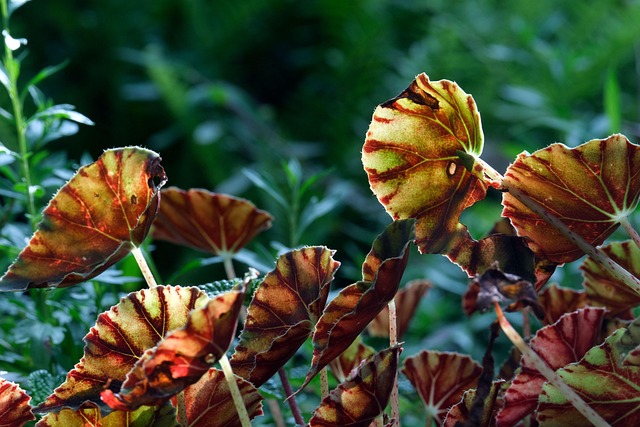
This alien-looking plant features perfect silver polka dots on top and blood-red undersides (an adaptation to catch scattered light in dark forests)

94%
Cause

This alien-looking plant features perfect silver polka dots on top and blood-red undersides (an adaptation to catch scattered light in dark forests). Crispy edges occur when the delicate leaves are misted, leading to fungal issues, or when exposed to direct sun.

Solutions
  • Never mist the leaves directly; use a humidifier instead
  • Keep the soil evenly moist but never soggy
  • Provide bright, filtered light—no direct afternoon sun
Prevention

Bottom-water the plant to keep the foliage completely dry and prevent powdery mildew.

Begonia Maculata: Dropping Leaves

Begonia maculata (Polka Dot Begonia) dropping leaves results from overwatering in moisture-retentive peat-heavy soil combined with shallow root systems intolerant of waterlogged conditions

2 protocols 87–89%

Protocol 1: dropping leaves · 89% confidence

Cause

Begonia maculata (Polka Dot Begonia) dropping leaves results from overwatering in moisture-retentive peat-heavy soil combined with shallow root systems intolerant of waterlogged conditions. The plant's epiphytic adaptations require oxygen-rich root environments; when soil remains saturated for 3-5 days, anaerobic bacteria proliferate, triggering root rot and leaf abscission as a survival mechanism to conserve energy.

Solutions
  • Repot immediately from peat-heavy mixes into well-draining aroid-style mix (40% potting soil, 30% perlite, 20% orchid bark, 10% charcoal)
  • Allow soil to dry completely between waterings; use finger test to 2nd knuckle before adding water
  • Trim any black, mushy roots during repotting using sterilized shears; treat cut surfaces with cinnamon powder
  • Switch to bottom-watering: Place pot in shallow water for 20-30 minutes, then drain thoroughly to prevent standing water
  • Maintain consistent bright indirect light (1000-2000 lux) to support transpiration and prevent moisture stagnation
Prevention

Water only when top 2 inches of soil are completely dry; use well-draining mix with 40% perlite or orchid bark; repot every 12-18 months to prevent soil compaction; maintain 50-60% ambient humidity without saturating soil.

Protocol 2: dropping leaves · 87% confidence

Cause

Extreme sensitivity to touch (mechanical stress), moisture fluctuations (bone-dry soil triggers defensive drop), and cold nighttime temperatures (<65�F).

Solutions
  • No-Touch Policy: Avoid touching the leaves or foliage; even slight handling can cause a leaf to abscise (drop) due to rapid turgor changes.
  • Soil Airation: Amend standard potting soil with 25% perlite or pumice. Dense soil remains saturated too long in winter, causing root anoxia.
  • Thrips Inspection: Check the junction where the leaf meets the stem (petiole) for dark spots or tiny insects; maculatas are thrips magnets.
  • Winter Warmth: Ensure temperatures never drop below 65�F at night. Use a heat mat if near a drafty window.
  • Watering: Bottom-water when the top 1 inch of soil is dry. Never let it go 100% bone-dry, as this kills the delicate feeder roots.
Prevention

Use a humidifier to maintain 50-60% RH. Group with other plants to create a humid microclimate. Avoid south-facing windows in summer to prevent scorch on the white polka dots.

Begonia Maculata: Leaf Crisping

Begonia maculata leaf crisping presents with multiple etiologies requiring differential diagnosis

89%
Cause

Begonia maculata leaf crisping presents with multiple etiologies requiring differential diagnosis. LOW HUMIDITY CRISPING: Affects leaf edges and tips first, progressing inward uniformly when RH drops below 45%. Cells lose turgor pressure from excessive transpiration. BACTERIAL LEAF SPOT (Xanthomonas axonopodis pv. begoniae): Angular water-soaked lesions that turn brown/black, often with yellow halos, vectored by fungus gnats and splashing water. POWDERY MILDEW (Oidium): White fuzzy patches on leaf surfaces thriving in high humidity with poor airflow. PHYSIOLOGICAL EDEMA: Blister-like corky spots from humidity over 80% with stagnant air causing cells to rupture.

Solutions
  • For humidity crisping: Increase RH to 60%+ using humidifier; trim affected edges with sterile scissors
  • For bacterial spot: Isolate plant immediately; remove infected leaves; apply copper-based bactericide; improve airflow with fan
  • For powdery mildew: Remove infected tissue; apply neem oil or potassium bicarbonate spray; reduce humidity slightly and increase ventilation
  • For edema: Reduce humidity to 60-70%; increase air circulation; avoid overwatering—allow top inch to dry
  • Prevention for all: Maintain 50-70% RH with consistent airflow using oscillating fan; bottom-water to avoid leaf wetness
Prevention

Maintain optimal humidity range of 50-70%—too low causes edge crisping, too high promotes pathogens. Use digital hygrometer for monitoring. Ensure 6+ hours of gentle air circulation daily with small fan. Quarantine new plants for 14 days. Inspect weekly for early signs—intervene at first symptom before spread.

How much light does my Begonia Maculata need?

Begonia maculata evolved as an understory plant in Brazil's Atlantic Forest, adapted to bright filtered light with dappled sun penetration through the canopy

91%
Cause

Begonia maculata evolved as an understory plant in Brazil's Atlantic Forest, adapted to bright filtered light with dappled sun penetration through the canopy. Scientific studies on Begonia species demonstrate that light quality and intensity regulate lipid metabolism and stress adaptation. Insufficient light causes leggy growth and leaf drop, while excessive direct sun causes photodamage and leaf scorch, particularly on the characteristic spotted foliage.

Solutions
  • Provide bright indirect light of 2000-4000 lux measured with light meter
  • Position 3-5 feet from south or west-facing windows with sheer curtain filtration
  • East-facing windows provide ideal morning sun without harsh afternoon intensity
  • Use grow lights if natural light is insufficient: LED full-spectrum 12-14 inches above plant for 12 hours daily
  • Rotate plant 90 degrees weekly to ensure even growth and prevent leaning
Prevention

Acclimate to new light conditions gradually over 7-10 days; monitor for signs of light stress (leggy growth = too little; brown crispy spots = too much direct sun); maintain consistent light levels year-round adjusting for seasonal changes.

Common Questions

Frequently Asked Questions

Why does my begonia maculata have Dropping leaves?

Cause: Begonia maculata (Polka Dot Begonia) dropping leaves results from overwatering in moisture-retentive peat-heavy soil combined with shallow root systems intolerant of waterlogged conditions. The plant's epiphytic adaptations require oxygen-rich root environments; when soil remains saturated for 3-5 days, anaerobic bacteria proliferate, triggering root rot and leaf abscission as a survival mechanism to conserve energy.

Solution: Repot immediately from peat-heavy mixes into well-draining aroid-style mix (40% potting soil, 30% perlite, 20% orchid bark, 10% charcoal)

Prevention: Water only when top 2 inches of soil are completely dry; use well-draining mix with 40% perlite or orchid bark; repot every 12-18 months to prevent soil compaction; maintain 50-60% ambient humidity without saturating soil.

89% confidence · View full protocol →

Why does my begonia maculata have Propagation?

Cause: Begonia maculata propagates readily from stem cuttings due to meristematic tissue at nodes that can differentiate into adventitious roots. The plant's natural habitat experiences seasonal flooding, creating an evolutionary adaptation for root development in moist conditions. However, prolonged water propagation leads to bacterial rot and weak water roots that struggle to transition to soil, explaining the high failure rate when cuttings are left in water too long.

Solution: Take 4-6 inch stem cuttings with 2-3 nodes, cutting just below a node with sterilized scissors

Prevention: Avoid extended water propagation beyond 3-4 weeks; transition immediately upon shoot emergence to leverage natural geophytic adaptation; use sterile tools and filtered water to prevent bacterial contamination.

87% confidence · View full protocol →

Why does my begonia maculata have Crispy edges on polka dot leaves?

Cause: This alien-looking plant features perfect silver polka dots on top and blood-red undersides (an adaptation to catch scattered light in dark forests). Crispy edges occur when the delicate leaves are misted, leading to fungal issues, or when exposed to direct sun.

Solution: Never mist the leaves directly; use a humidifier instead

Prevention: Bottom-water the plant to keep the foliage completely dry and prevent powdery mildew.

94% confidence · View full protocol →

Why does my begonia maculata have Light needs?

Cause: Begonia maculata evolved as an understory plant in Brazil's Atlantic Forest, adapted to bright filtered light with dappled sun penetration through the canopy. Scientific studies on Begonia species demonstrate that light quality and intensity regulate lipid metabolism and stress adaptation. Insufficient light causes leggy growth and leaf drop, while excessive direct sun causes photodamage and leaf scorch, particularly on the characteristic spotted foliage.

Solution: Provide bright indirect light of 2000-4000 lux measured with light meter

Prevention: Acclimate to new light conditions gradually over 7-10 days; monitor for signs of light stress (leggy growth = too little; brown crispy spots = too much direct sun); maintain consistent light levels year-round adjusting for seasonal changes.

91% confidence · View full protocol →

Why does my begonia maculata have Care requirements?

Cause: Begonia maculata (Polka Dot Begonia) is a tropical understory plant native to Brazil's Atlantic Forest, requiring specific environmental conditions to thrive. The plant's distinctive spotted foliage and cane-like stems evolved in high-humidity (60-80% RH), warm (65-80°F), and bright filtered light conditions. Its rhizomatous root system is highly susceptible to anaerobic conditions, making soil composition and watering practices critical to survival.

Solution: Maintain ambient humidity at 60-80% using a humidifier or pebble tray—never mist leaves directly as this promotes powdery mildew

Prevention: Establish consistent environment before plant arrival: set up humidifier 2-3 days prior, acclimate gradually over 7-10 days, use clear nursery pots to monitor root health, and maintain stable temperatures between 65-80°F year-round.

90% confidence · View full protocol →

Common Questions

Frequently Asked About Begonia Maculata

What problems can Begonia Maculata get?

Our database contains 13 documented Begonia Maculata cases covering 11 distinct topics, including diseases, pest identification, environmental stress, propagation, and advanced care protocols — each with verified solutions.

Structured Learning

Ready to Go Deeper?

Explore our Mastery Packs for structured, video-based learning with step-by-step protocols from 20,000+ analyzed plant cases.

Browse All Courses →