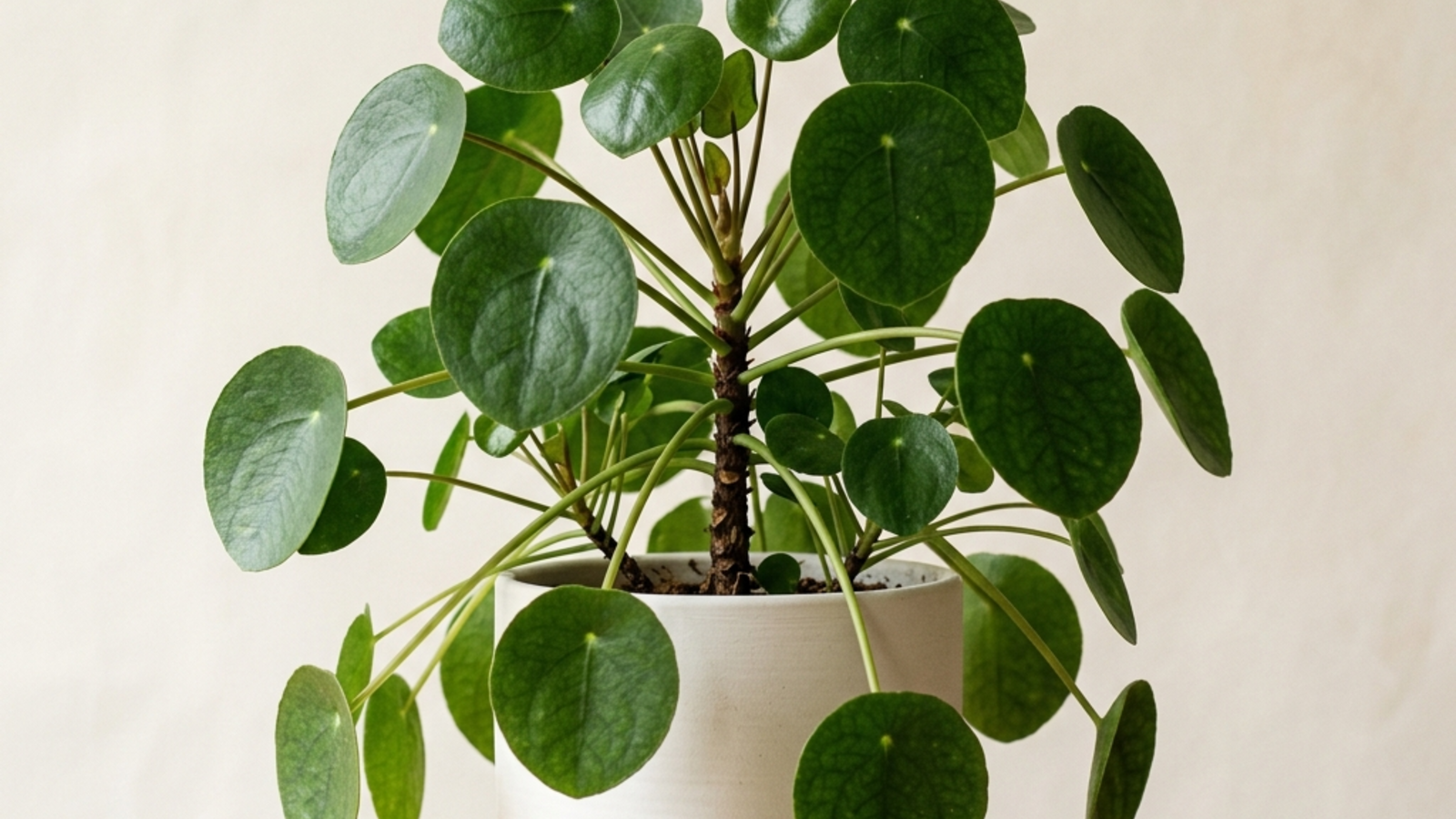
The Chinese money plant earned its following with one feature: round leaves on long stalks that attach at the centre, like lily pads on stems. NC State Extension describes it as compact and easy to care for. Most problems trace back to a pot that stays wet, a sunny windowsill, or a plant that has grown tall and bare.
This guide covers Pilea peperomioides, also sold as pancake plant, UFO plant or missionary plant. A short section at the end covers two other Pileas grown indoors: aluminum plant (Pilea cadierei) and friendship plant (Pilea involucrata).
NC State says Pilea peperomioides comes from Yunnan Province in southern China, where it grows in shady, cool mountain areas. It belongs to the nettle family (Urticaceae). Indoors it usually reaches 20–30 cm (8–12 in) tall and wide, with leaves up to 10 cm (4 in) across.
Chinese money plant care at a glance
| Factor | What the sources say |
|---|---|
| Light | Bright, indirect light (NC State, RHS). Near a north, east or west window; set back from a south one (RHS) |
| Water | When the top few centimetres dry out; less in winter; never leave it standing in water (RHS) |
| Mix | Moist, well-drained potting mix (NC State); peat-free multi-purpose compost (RHS) |
| Temperature | Warm room, always above 10 °C (50 °F), out of cold draughts (RHS). Avoid heat sources (NC State) |
| Humidity | Moderate to high is best, but it tolerates average home humidity (NC State) |
| Feeding | Balanced liquid feed every month or two, April to September (RHS) |
| Repotting | Check roots each spring; usually every couple of years (RHS) |
| Propagation | Offsets, stem cuttings, division or leaf cuttings (NC State, RHS) |
| Pets | Safe for pets (NC State) |
Light: bright, indirect, and turn the pot
NC State and the RHS both recommend bright, indirect light. The RHS suggests a north-, east- or west-facing window. In a south-facing room, keep the plant back from the glass, especially in summer.
Direct sun shows on the leaves. The RHS links red-brown flushed leaves to too much direct sun.
A Pilea grows toward its light source, and the round leaves make the lean obvious. The RHS tip is simple: turn the pot a quarter turn each time you water.
Watering: check the top few centimetres
The RHS advice is to water once the top few centimetres of compost start to dry. Check with a finger, or lift the pot to feel its weight. Clemson Extension notes that a drying pot is noticeably lighter, which makes the lift test useful for small pots.
Three rules from the RHS:
- Empty the saucer. Waterlogged compost can kill the roots, so discard any water left in the saucer or outer pot.
- Water less in winter. Growth slows, and the pot dries more slowly.
- Rainwater or filtered water is ideal, although Pileas tolerate tap water.
NC State asks for a moist, well-drained mix. Read that as evenly moist between waterings, never soggy.
Mix, pot and repotting
The RHS recommends peat-free multi-purpose compost. Choose a pot only a couple of centimetres larger than the old one. An oversized pot keeps compost damp for too long, which can lead to root rot.
Pileas grow fast; NC State rates the growth rate as rapid. The RHS suggests checking the roots each spring and repotting when they start to crowd, usually every couple of years. A newly bought plant can usually stay in its pot for the first year unless the roots are congested.
Humidity and temperature
NC State says the plant thrives in moderate to high humidity but tolerates average home humidity. The RHS agrees that most Pileas grow well in the relatively dry air of most homes.
Keep it warm. The RHS sets a floor of 10 °C (50 °F) and warns against cold draughts. NC State adds that sources of heat should be avoided too, so keep it away from radiators and heaters.
Feeding
The RHS suggests feeding every month or two from April to September, with a balanced liquid fertiliser at the label dilution. Do not overfeed; the RHS warns it can do more harm than good. If leaves yellow between the veins, the RHS points to a nutrient shortage and a balanced houseplant feed.
Propagation: offsets, cuttings and leaves
This is the easiest part of growing a Pilea. The RHS lists four methods:
- Offsets. Pilea peperomioides readily produces baby plants around its base. Detach them once they are large enough and pot them up individually.
- Stem cuttings. NC State lists stem cuttings as the recommended strategy, in spring or early summer.
- Division. Split a clump in spring or summer, making sure each piece has plenty of roots and healthy shoots.
- Leaf cuttings. Single leaves of P. peperomioides will root in water or in pots of moist compost.
For a tall, woody plant that has lost vigour, the RHS suggests propagating new plants and discarding the old one. Tall stems can also be cut back in spring or summer to encourage new growth from the base.
Problems and what to check
There are no Plant Grail diagnosis guides for Pilea yet. Use this table from the RHS problem list, then the linked general guides.
| What you see | Likely cause (RHS unless noted) | What to do |
|---|---|---|
| Red-brown flushed leaves | Too much direct sun | Move back from the window |
| Curling or puckered leaves | Too much or too little water, or not enough light | Check the mix and the light before changing anything |
| Yellowing between the veins | Nutrient deficiency | Apply a balanced houseplant feed |
| White deposits under leaves | Mineral deposits, or sap from guttation after temperature swings | Often harmless; check for temperature swings |
| Leaning, lopsided plant | Growth toward light | Turn the pot a quarter turn each watering |
| Wet mix, collapsing stems | Root rot from waterlogging | Check roots; see our root rot guide |
| Webbing, speckled leaves | Red spider mites | See our spider mite guide |
| Cottony tufts, bumps or tiny streaked insects | Mealybugs, scale or thrips | Isolate and inspect stems and leaf undersides |
| Grey fuzzy mould | Grey mould in humid conditions such as terrariums | Remove affected leaves; lower the humidity around it |
Other Pileas: aluminum plant and friendship plant
Several other Pilea species are sold as houseplants. The RHS divides them into upright bushy types and trailing types. The two most common after the Chinese money plant need warmer, more humid conditions.
| Aluminum plant (Pilea cadierei) | Friendship plant (Pilea involucrata) | |
|---|---|---|
| Look | Dark green toothed leaves with raised silver patches, also called watermelon pilea (NC State) | Quilted, velvety leaves, bronze-green on top and red underneath (NC State) |
| Size | Shrubby clump to about 30 cm (12 in) (NC State) | 8–30 cm (3–12 in), trailing (NC State) |
| Light | Bright indirect, no full sun (NC State); tolerates low light (Missouri) | Bright indirect (NC State) |
| Humidity | High; a humid room or wet pebble tray (NC State, Missouri) | High (NC State); a terrarium or damp pebbles (RHS) |
| Water | Moderately in the growing season, less from autumn to late winter (NC State) | Same as aluminum plant (NC State) |
| Propagation | Stem-tip cuttings in spring and summer (RHS, Illinois) | Stem-tip cuttings in spring and summer (RHS) |
| Pets | Non-toxic to dogs, cats and horses (ASPCA) | Non-toxic to dogs, cats and horses (ASPCA) |
NC State recommends a peaty, soil-based mix for both, and pinching stem tips to keep plants compact. For aluminum plant, NC State notes the best foliage is on young plants, so some growers take cuttings each early spring and replace the parent.
Is Pilea safe for pets?
NC State describes Pilea peperomioides as safe for pets and children. The ASPCA has no entry for the Chinese money plant. It does list the aluminum plant and friendship plant as non-toxic to dogs, cats and horses. See our pet-safe plants guide for more options, and the Pilea peperomioides hub.
References
- NC State Extension Gardener Plant Toolbox: Pilea peperomioides
- NC State Extension Gardener Plant Toolbox: Pilea cadierei
- NC State Extension Gardener Plant Toolbox: Pilea involucrata
- Royal Horticultural Society: How to grow pilea
- University of Missouri Extension, D. H. Trinklein: Lighting Indoor Houseplants, G6515
- University of Illinois Extension: Houseplants: Propagation
- Clemson Cooperative Extension HGIC 1459: Indoor Plants – Watering
- ASPCA Animal Poison Control Center: Aluminum Plant
- ASPCA Animal Poison Control Center: Friendship Plant