prickly pear cactus
Evidence-based care guide for Prickly Pear Cactus (). Covers watering. Our analysis draws from 4 verified community cases with an average confidence score of 89%. Each protocol is synthesized from real rescue outcomes, not generic advice.
Care Essentials
Get to Know Your Prickly Pear Cactus
The #1 killer? Overwatering. Let the soil dry between waterings and your Prickly Pear Cactus will thrive.
Light
bright indirect
Prefers bright, indirect light. Keep out of harsh direct afternoon sun — it can scorch the leaves.
💡 Grow lights: Thrives under artificial grow lights (LED or fluorescent, 10-12 hours/day). A great option if your space lacks natural light.
Watering
every 7-10 days
Water when the top 1-2 inches of soil feel dry. Adjust with the seasons — less in winter, more in summer.
Humidity & Temperature
Not fussy about humidity. Handles average indoor conditions without issue.
Standard room temperature (60-80°F / 15-27°C) is perfect. Avoid cold drafts and sudden temperature swings.
Soil
Use a moisture-retentive potting mix with some peat or coco coir. Avoid overly chunky mixes that dry out too fast.
Care Requirements
At a Glance
Care Profile in Development
While our detailed care profile is being compiled, you can find specific care guidance in the 2 care-related diagnoses below — including watering schedules, light requirements, and propagation methods from real-world cases.
Start Here
Most Common Problems
Based on 4 analyzed cases — these are the issues you're most likely to encounter
Don't see your symptom? Search all 4 topics below, or run the Diagnostic.
How often should I water my Prickly Pear Cactus?
Cacti evolved for arid environments with infrequent rainfall followed by...
Why does my Prickly Pear Cactus have sunburn?
Sunburn creates permanent tissue damage that prickly pear cacti cannot...
Is my Prickly Pear Cactus overwatered?
Prickly pear and paddle cacti are uniquely vulnerable to both overwatering and...
Prickly Pear Cactus: Corking
Opuntia and prickly pear cacti exhibit a unique corking pattern on their flat,...
Which of the 7 Killers
is threatening your plants?
We analyzed 1,616 documented plant deaths to identify the 7 causes behind 78% of all losses. Answer 5 questions — we'll tell you exactly which ones apply to your setup.
Skip the quiz — get The 7 Killers course ($19) →Question 1 of 5
How do you decide when to water your plants?
Question 2 of 5
Where do most of your plants live?
Question 3 of 5
What's your home environment like?
Question 4 of 5
Have you lost a plant in the last 6 months?
Question 5 of 5
How often do you check your plants for pests?
Your diagnosis is ready
We've identified your top 2 risk killers. Enter your email to see the full breakdown and your personalized rescue protocol.
Your plants are most at risk from:

The 7 Killers mini-course covers every one of these in depth — mechanism, rescue protocol, prevention. 1,616 cases. 7 lessons. $19.
Get The 7 Killers — $19 →Get the Plant Mortality Checklist
The 7 killers behind 78% of houseplant deaths — and the exact fix for each. Free PDF based on 1,616 documented cases.
Your checklist is ready!
We also sent it to your inbox. Check your email for the full download.
Open the ChecklistFree. No spam. Unsubscribe anytime.
Verified Data
All Diagnoses
4 topics consolidated from 4 documented cases. Expand any topic to see all protocols.
Watering Issues (2 topics · 2 cases)
Is my Prickly Pear Cactus overwatered?
Prickly pear and paddle cacti are uniquely vulnerable to both overwatering and underwatering because their native desert habitats feature infrequent but intense rainfall events followed by extended drought periods
88%
Is my Prickly Pear Cactus overwatered?
Prickly pear and paddle cacti are uniquely vulnerable to both overwatering and underwatering because their native desert habitats feature infrequent but intense rainfall events followed by extended drought periods
Cause
Prickly pear and paddle cacti are uniquely vulnerable to both overwatering and underwatering because their native desert habitats feature infrequent but intense rainfall events followed by extended drought periods. The diagnostic challenge arises because both conditions eventually produce similar above-ground symptoms (wrinkling, drooping, pad deflation) through different mechanisms. Overwatering kills roots first (preventing water uptake), then causes stem rot; underwatering simply depletes stored water in pads. Without proper soil moisture assessment, owners cannot determine which condition exists until significant damage has occurred.
Solutions
- Finger test: Insert finger 2-3 inches deep—if soil particles cling to skin or feel cool, soil contains moisture; if completely dry and crumbly, ready for water
- Wooden skewer method: Insert bamboo skewer or chopstick to pot bottom, withdraw—damp residue or darkened wood indicates moisture throughout pot; clean, dry skewer signals readiness for watering
- Pot weight test: Lift pot when bone-dry to establish baseline weight; water only when pot feels similarly lightweight
- Moisture meter verification: For precision, use meter probe inserted to root depth—reading below 2/10 confirms dryness for cacti
- Seasonal adjustment: Extend dry periods in winter (dormancy) to 4-6 weeks; shorten to 2-3 weeks in active growth season with bright light
Prevention
Implement systematic soil moisture monitoring: Use combination of finger test (top 2-3 inches), wooden skewer method (insert to pot bottom, check for dampness), and pot weight assessment (lift pot—lightweight indicates dryness). Establish environment-specific watering schedules rather than calendar-based routines.
How often should I water my Prickly Pear Cactus?
Cacti evolved for arid environments with infrequent rainfall followed by extended dry periods
91%
How often should I water my Prickly Pear Cactus?
Cacti evolved for arid environments with infrequent rainfall followed by extended dry periods
Cause
Cacti evolved for arid environments with infrequent rainfall followed by extended dry periods. Their shallow, fibrous root systems and CAM photosynthesis enable drought tolerance but make them highly susceptible to root rot in chronically moist soil. Overwatering is fundamentally about frequency, not volume—watering every 7-14 days creates anaerobic conditions where Pythium and Fusarium thrive, even with small amounts. Underwatering manifests as wrinkling from gradual water depletion, while overwatering causes rapid root death that paradoxically also produces wrinkling as roots lose uptake capability.
Solutions
- Implement 'soak and dry' cycle: Water thoroughly until effluent exits drainage holes, ensuring complete root ball saturation
- Wait until soil is bone-dry 2-3 inches deep (finger test or wooden skewer probe) before next watering
- Adjust frequency seasonally: every 3-4 weeks in active growth (spring-summer), 6-8 weeks in dormancy (fall-winter)
- For recovery from overwatering: Unpot, trim black/mushy roots, allow 48-hour callusing, repot in dry gritty mix, withhold water 1-2 weeks
- Monitor via pot weight: Lift pot—heavy with wrinkled leaves indicates waterlogged roots (overwatering), light with wrinkled leaves indicates true thirst
Prevention
Water only when soil is completely dry; use terracotta pots for moisture wicking; ensure drainage holes; maintain bright light to support transpiration; never water on fixed calendar schedules—always verify dryness first.
Environment (1 topics · 1 cases)
Why does my Prickly Pear Cactus have sunburn?
Sunburn creates permanent tissue damage that prickly pear cacti cannot repair—the necrotic epidermal and cortical cells are dead and will not regenerate
88%
Why does my Prickly Pear Cactus have sunburn?
Sunburn creates permanent tissue damage that prickly pear cacti cannot repair—the necrotic epidermal and cortical cells are dead and will not regenerate
Cause
Sunburn creates permanent tissue damage that prickly pear cacti cannot repair—the necrotic epidermal and cortical cells are dead and will not regenerate. However, this damage is primarily cosmetic. The plant continues photosynthesis through unaffected cladode tissue and produces new growth from areoles. Over 6-18 months, new pads emerge that display normal coloration, gradually making scars less prominent as the plant increases in size. The critical factor is preventing secondary fungal or bacterial infection in the damaged zones.
Solutions
- Set realistic expectations: damaged tissue remains; new growth only comes from areoles, not healed scars
- Monitor scorched zones monthly for softening, spreading discoloration, or orange/black fungal growth indicating secondary infection
- If infection appears: surgically excise affected tissue with sterile blade until firm white tissue is visible; treat cut with cinnamon powder
- Maintain consistent care—avoid overcompensating with extra water or fertilizer which stresses recovering plants
- Photograph monthly to document new growth emergence; expect first new areole activity within 4-8 weeks in growing season
- Consider aesthetic positioning: place scarred cladodes toward wall or among other plants until new growth obscures damage
Prevention
Accept that sunburn scars are permanent markers of learning—use them as visual reminders for acclimation protocols. Maintain 40-60% humidity around recovering cacti to reduce desiccation stress on damaged tissue while avoiding wet conditions that promote infection. Position damaged plants where scars are less visible if aesthetics are a concern.
Other Topics (1 topics · 1 cases)
Prickly Pear Cactus: Corking
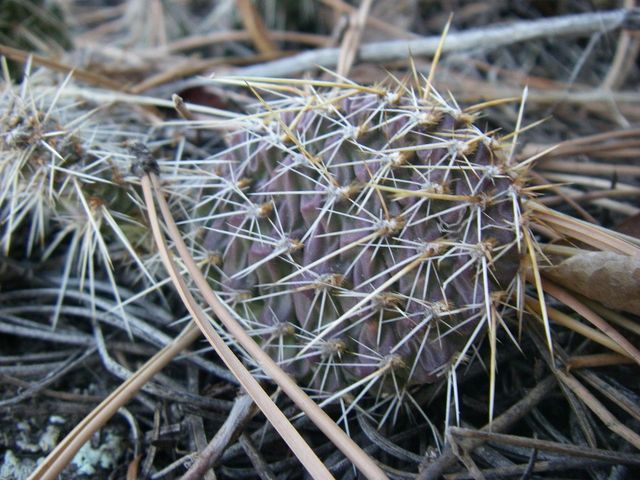
Opuntia and prickly pear cacti exhibit a unique corking pattern on their flat, pad-like stem segments (cladodes)
88%
Prickly Pear Cactus: Corking
Opuntia and prickly pear cacti exhibit a unique corking pattern on their flat, pad-like stem segments (cladodes)
Cause
Opuntia and prickly pear cacti exhibit a unique corking pattern on their flat, pad-like stem segments (cladodes). As these cacti age, the older pads at the base of the plant develop woody, brown tissue while continuing to support newer green pads above. The junction points between pads are particularly prone to corking due to mechanical stress from the weight of stacked segments. This pattern differs from cylindrical cacti because the flat pads create different stress distributions across the plant structure.
Solutions
- Identify Opuntia-specific pattern: Expect woody base pads with newer green pads stacked above
- Check junction health: The points where pads connect should remain firm; soft junctions indicate rot
- Monitor pad turgidity: Even corked base pads should remain somewhat plump, not completely desiccated
- Watch for new growth: Healthy plants continue producing new pads at branch tips regardless of basal corking
- Remove if necessary: Severely corked, desiccated base pads can be removed if they threaten plant health
Prevention
Provide adequate spacing between plants to prevent pads from rubbing and causing mechanical damage that could mimic or trigger abnormal corking; maintain proper watering to keep pads turgid and healthy.
Common Questions
Frequently Asked Questions
Why does my prickly pear cactus have Watering frequency?
Cause: Cacti evolved for arid environments with infrequent rainfall followed by extended dry periods. Their shallow, fibrous root systems and CAM photosynthesis enable drought tolerance but make them highly susceptible to root rot in chronically moist soil. Overwatering is fundamentally about frequency, not volume—watering every 7-14 days creates anaerobic conditions where Pythium and Fusarium thrive, even with small amounts. Underwatering manifests as wrinkling from gradual water depletion, while overwatering causes rapid root death that paradoxically also produces wrinkling as roots lose uptake capability.
Solution: Implement 'soak and dry' cycle: Water thoroughly until effluent exits drainage holes, ensuring complete root ball saturation
Prevention: Water only when soil is completely dry; use terracotta pots for moisture wicking; ensure drainage holes; maintain bright light to support transpiration; never water on fixed calendar schedules—always verify dryness first.
91% confidence · View full protocol →
Why does my prickly pear cactus have Sunburn?
Cause: Sunburn creates permanent tissue damage that prickly pear cacti cannot repair—the necrotic epidermal and cortical cells are dead and will not regenerate. However, this damage is primarily cosmetic. The plant continues photosynthesis through unaffected cladode tissue and produces new growth from areoles. Over 6-18 months, new pads emerge that display normal coloration, gradually making scars less prominent as the plant increases in size. The critical factor is preventing secondary fungal or bacterial infection in the damaged zones.
Solution: Set realistic expectations: damaged tissue remains; new growth only comes from areoles, not healed scars
Prevention: Accept that sunburn scars are permanent markers of learning—use them as visual reminders for acclimation protocols. Maintain 40-60% humidity around recovering cacti to reduce desiccation stress on damaged tissue while avoiding wet conditions that promote infection. Position damaged plants where scars are less visible if aesthetics are a concern.
88% confidence · View full protocol →
Why does my prickly pear cactus have Overwatering vs underwatering?
Cause: Prickly pear and paddle cacti are uniquely vulnerable to both overwatering and underwatering because their native desert habitats feature infrequent but intense rainfall events followed by extended drought periods. The diagnostic challenge arises because both conditions eventually produce similar above-ground symptoms (wrinkling, drooping, pad deflation) through different mechanisms. Overwatering kills roots first (preventing water uptake), then causes stem rot; underwatering simply depletes stored water in pads. Without proper soil moisture assessment, owners cannot determine which condition exists until significant damage has occurred.
Solution: Finger test: Insert finger 2-3 inches deep—if soil particles cling to skin or feel cool, soil contains moisture; if completely dry and crumbly, ready for water
Prevention: Implement systematic soil moisture monitoring: Use combination of finger test (top 2-3 inches), wooden skewer method (insert to pot bottom, check for dampness), and pot weight assessment (lift pot—lightweight indicates dryness). Establish environment-specific watering schedules rather than calendar-based routines.
88% confidence · View full protocol →
Why does my prickly pear cactus have Corking?
Cause: Opuntia and prickly pear cacti exhibit a unique corking pattern on their flat, pad-like stem segments (cladodes). As these cacti age, the older pads at the base of the plant develop woody, brown tissue while continuing to support newer green pads above. The junction points between pads are particularly prone to corking due to mechanical stress from the weight of stacked segments. This pattern differs from cylindrical cacti because the flat pads create different stress distributions across the plant structure.
Solution: Identify Opuntia-specific pattern: Expect woody base pads with newer green pads stacked above
Prevention: Provide adequate spacing between plants to prevent pads from rubbing and causing mechanical damage that could mimic or trigger abnormal corking; maintain proper watering to keep pads turgid and healthy.
88% confidence · View full protocol →
Common Questions
Frequently Asked About Prickly Pear Cactus
What problems can Prickly Pear Cactus get?
Our database contains 4 documented Prickly Pear Cactus cases covering 4 distinct topics, including diseases, pest identification, environmental stress, propagation, and advanced care protocols — each with verified solutions.
Structured Learning
Ready to Go Deeper?
Explore our Mastery Packs for structured, video-based learning with step-by-step protocols from 20,000+ analyzed plant cases.
Browse All Courses →