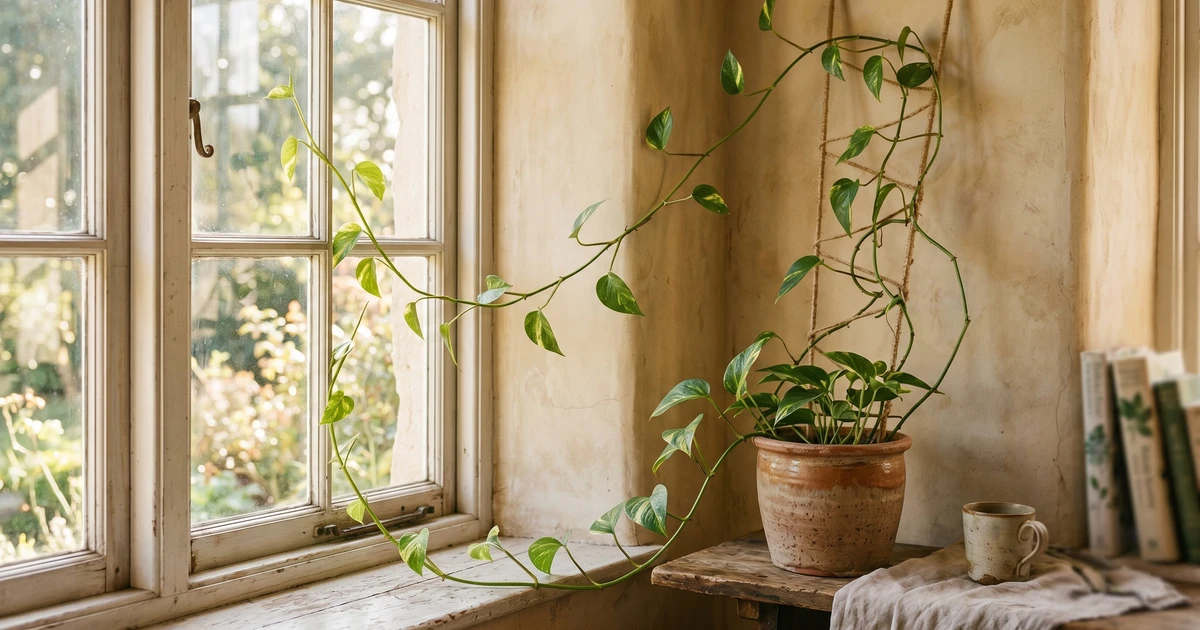
leggy on English Ivy
Quick answer
If your English Ivy has leggy, the most likely cause is: Leggy growth (etiolation) in English ivy results from insufficient photosynthetically active radiation (PAR). The plant stretches internodes and reduces leaf production at lower nodes while directing energy toward apical growth seeking light. Low light (<500 foot-candles) triggers this survival mechanism, causing sparse foliage, extended stem segments, and basal leaf drop as the plant reallocates resources.
Start here:
- 1. Prune back leggy stems by 1/3 to 1/2 length, cutting just above a leaf node to stimulate branching from that point
- 2. Move plant to brighter location with east or west-facing window exposure, or install grow light 12-18 inches above foliage
Why English Ivy gets leggy
Hedera helix
Leggy growth (etiolation) in English ivy results from insufficient photosynthetically active radiation (PAR). The plant stretches internodes and reduces leaf production at lower nodes while directing energy toward apical growth seeking light. Low light (<500 foot-candles) triggers this survival mechanism, causing sparse foliage, extended stem segments, and basal leaf drop as the plant reallocates resources.
How to reverse leggy on English Ivy
- 1
Prune back leggy stems by 1/3 to 1/2 length, cutting just above a leaf node to stimulate branching from that point
- 2
Move plant to brighter location with east or west-facing window exposure, or install grow light 12-18 inches above foliage
- 3
Pinch growing tips monthly during growing season to encourage lateral branching and bushier form
- 4
Propagate pruned cuttings to create fuller appearance in original pot while new growth establishes
- 5
Supplement with full-spectrum LED grow light on timer (12-14 hours/day) if natural light insufficient; expect compact new growth in 4-6 weeks
Keep leggy off this English Ivy
Provide minimum 1000-2000 foot-candles bright indirect light year-round. Use full-spectrum LED grow lights (12-14 hours daily) during winter months. Rotate plant 90° weekly for even light distribution. Choose compact cultivars (e.g., 'Glacier', 'Needlepoint') for lower light conditions.